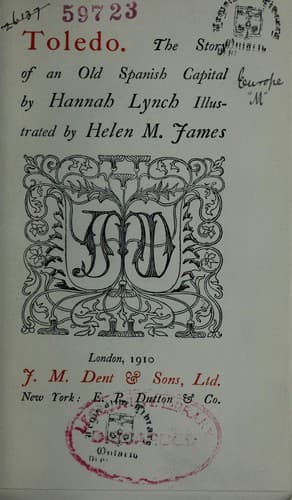
Toledo, the Story of an Old Spanish CapitalLynch, Hannah
History
Toledo, the Story of an Old Spanish Capital
Lynch, Hannah
Toledo (Spain) -- Description and travel; Toledo (Spain) -- History
help the Castillians against the Moors; but Ambrosio de Morales is of
opinion that they were taken to Oviedo, which would have been at the
date of the Moorish conquest, when Favila and Pelayo, with their
Asturian followers, were at Rodrigo's court. For their reception at
Toledo, all the town went out in procession under triumphal arches,
banners flying, trumpets blowing. A throne was erected at the Puerta
Bisagra, and a chapel, where eight dignitaries and canons received the
relics; and the procession turned back, with music, singing and dancing.
Every parish had its banner wrought for the occasion, and each child
carried a flag. More than a thousand monks walked behind; and, as well
as fifteen hundred priests of the town, there were all the canons, the
Brotherhood of the Hermandad, foreign priests, and every order of the
Catholic Church was present. Then came all the officers and ministry of
the Inquisition, more than seven hundred and forty doctors and masters,
fifty-five juries, thirty-three magistrates, the mayor, the Duke of
Maqueda, the Count of Fuensalida and Pedro de Silva, the city
standard-bearer. All the grandees of Castille followed--six dukes, nine
marquises, six counts, quantities of minor noblemen, and a regiment of
cavaliers and lords. The procession went by all the principal streets
from the Puerta Bisagra to the Cathedral. All were gaily decorated with
tapestries and silks, and arches were built everywhere, with Latin
inscriptions and elegant verses among their bright flowers. At the
Cathedral doors, Philip II., his two children, Don Carlos and Doña
Ysabel Clara, his sister, Doña Maria de Austria, and the Princes Rodolph
and Ernest of Hapsburg stood in the porch to receive the relics. The
majesty of the ceremony here becomes so dazzling that our prolix friend,
Dr Pisa, lays down his pen and weeps from emotion. He cannot hope to
trace such a picture, nor can we. But we strive to imagine the splendour
of Cardinal Quiroga in his sumptuous pontifical robes, a blaze of gold,
brocade and jewels, such as not to be beheld out of Eastern legend; the
dignitaries with their jewelled mitres; the King, infantas and princes,
all hardly less resplendent, and the laity rivalling them as far as
possible, in the gemmed lights of Toledo's glorious cathedral. A picture
one would gladly have seen, if it could be seen at a price less terrible
than that of Philip's contemporary or subject.
Public-domain text, read in full here on John Shaqi.
Reviews
Reviews
No reviews yet
Be the first to share your thoughts on this work.
Elsewhere in the archive
Join the Discussion
Join the discussion
Sign in to leave a comment or review.
Sign InorCreate an account