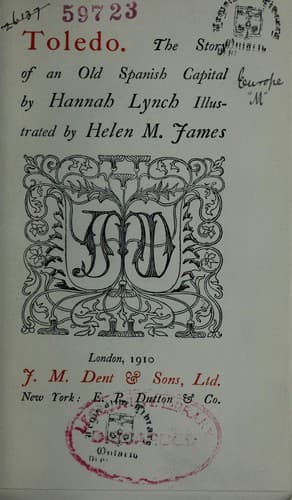
Toledo, the Story of an Old Spanish CapitalLynch, Hannah
History
Toledo, the Story of an Old Spanish Capital
Lynch, Hannah
Toledo (Spain) -- Description and travel; Toledo (Spain) -- History
The Exchange of Toledo was the most important of Spain. It was founded
by Martin Ramirez, in the parish of St Nicholas, near San José. Near
here the gilders and silversmiths worked, and their work was as prized
as it was costly; while the tanners, leather-cutters and dyers were
relegated to the barriers above the river, between the mills of the
Hierro and San Sebastian. The potters lived at the top of the town,
under San Isidro, and spread everywhere were countless weavers of cloth,
and silk and fine embroiderers. Running from the Zocodover to the Puerta
de Perpiñan was the famous street of arms where the sword-makers, the
armourers, the iron and damascene-workers lived, and in the wide street
opposite (now the _calle del Comercio_) the shoemakers and jewellers had
their shops. The Jews had their own barrier before their expulsion, one
of the wealthiest and most important of the city.
The four streets on the further side of the Cathedral were called the
_Alcayzerias_, and here dwelt the silk-sellers, the hosiers, the
linen-sellers, the clothiers and haberdashers. These shopkeepers did an
enormous trade with Valencia, Xativa, Murcia; with Medina del Campo,
Medina del Rioseca, Sevilla, Cádiz and Ecija, even as far as Portugal.
After the discovery of America all the ships that went out laden with
Spanish goods purchased these at Toledo. The scriveners dwelt round the
Ayuntamiento.
In early days the Ayuntamiento was an insignificant body, and all the
power lay between the sovereign and the mighty archbishop. But after the
conquest of the Saracens, the kings of Castille found their realm too
large and complicated for anything so minute as mere civic rule, and
gradually the magistrature increased in power, till this Ayuntamiento,
with its president, came to be the important body it was, and rivalled
the Archbishopric in semi-royal powers. Pedro the Cruel was the first to
grant it the privilege of the arms of Castille, and it was to the famous
Corregidor, Gomez Manrique, who had his namesake's famous inscription
painted on the staircase, that Isabel the Catholic, on her first visit,
gave the castles and gates of the city. Under the Corregidor were four
mayors, who judged civil cases, one of whom sat only in the Zocodover to
settle disputes between the traders. These magistrates were usually
powerful nobles, such as the Toledos--the present dukes of Alba--the
Castillas, the Silvas, the Ayalas, Montemayors and Fuensalidas, all
great historic names. The city jury, half Latin, half Mozarabe, in
religion, was furnished by all the parishes. As well as the
Ayuntamiento, there was the Santa Hermandad behind the Plaza Mayor, with
its prison and officers. To-day it is a muleteer's inn, the _Posada de
la Hermandad_, and the big kitchen, once the judgment chamber of the
Inquisition, and the wooden benches around have not been changed, nor
the dark-beamed ceiling within the Gothic façade, with the royal arms
Public-domain text, read in full here on John Shaqi.
Reviews
Reviews
No reviews yet
Be the first to share your thoughts on this work.
Elsewhere in the archive
Join the Discussion
Join the discussion
Sign in to leave a comment or review.
Sign InorCreate an account