A Short Summary, With Some Explanations of Concepts Presented by
Hughes, but Not Well Defined by Him, Being Apparently Well
Understood in His Day, but With Which Modern Readers May be
Unfamiliar.
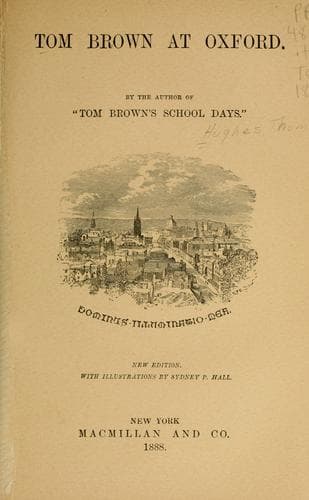
This is the sequel to Hughes' more successful novel _Tom Brown's
School Days_, which told about Tom at the Rugby School from the
age of 11 to 16. Now Tom is at Oxford University for a three year
program of study, in which he attends class lectures and does
independent reading with a tutor. A student in residence at
Oxford is said to be "up" or have "come up", and one who leaves
is said to have gone "down".
The author weaves a picture of life at Oxford University in the
1840s, where he himself was at that time, at Oriel College, where
he excelled in sports rather than academics. The University is
made up of a number of separate colleges, and the students form
friendships within and develop a loyalty to their own college.
Tom's college, St. Ambrose, is fictional. The study programs
available to the students are intended to prepare them for the
legal, ecclesiastical, medical and educational professions.
Students who do poorly might be expected to enter the diplomatic
corps or the army or navy, though a son of the aristocracy might
be thrust into a minor church role. To enter into business or
manufacturing engineering or the research sciences would require
an inheritance or family connection.
Latin was still taught because the best literature available to
them was still the ancient Greek and Roman poets and
philosophers, and the legal and medical professions still used it
extensively, though the ecclesiastical and educational fields had
largely abandoned it.
Tom finds that there is a social barrier between the wealthy
students and the students that are there on the equivalent of a
modern academic scholarship, or have to work as a graduate
student tutor to earn their stipend. There were no sports
scholarships at this time, though the author hints vaguely at one
point that someday the idea could be explored.
There were no female students at this time. Tom becomes involved
with a local barmaid. The barmaid being of a different social
class than Tom, this relationship causes problems for both of
them, and it is important for the modern reader to realize that
such social distinctions were very real and inflexible in those
days. The working class referred to the educated class as their
"betters", meaning better educated and entitled to better
respect, regardless of whether it was earned or deserved.
Public-domain text, read in full here on John Shaqi.
Reviews
Reviews
No reviews yet
Be the first to share your thoughts on this work.
Join the Discussion
Join the discussion
Sign in to leave a comment or review.
Sign InorCreate an account