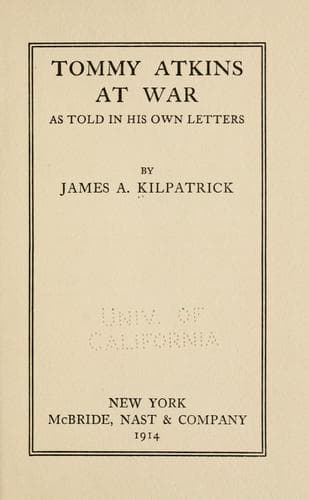
Tommy Atkins at War: As Told in His Own Letters — John Shaqi
Tommy Atkins at War: As Told in His Own LettersKilpatrick, James Alexander
History
Tommy Atkins at War: As Told in His Own Letters
Kilpatrick, James Alexander
Great Britain. Army -- Military life; World War, 1914-1918
"He died doing his duty like the officer and gentleman he was." Could
any man have a finer epitaph? It is an extract from a letter written by
Private J. Fairclough, Yorkshire Light Infantry, to General A. Wynn, and
refers to the death of the General's son, Lieutenant G.O. Wynn, killed
in action at Landrecies. The letter goes on to tell of the affection in
which the young officer was held by his men, and this story of courage
and unselfishness in the field is the simple but faithful tribute of a
devoted soldier.
The war has brought out in a hundred ways the admirable qualities of all
ranks in the British Expeditionary Force; but the relations of officers
and men have never been revealed to us before with such friendly candor
and mutual appreciation. Over and over again in these letters from the
front the soldiers are found extolling the bravery and self-sacrifice
of their officers. "No praise is too great for them," "our officers
always pull us through," "they know their business to the finger-tips,"
"as cool as cucumbers under fire," "magnificent examples," "absolutely
fearless in the tightest corners"--these are some of the phrases in
which the men speak proudly of those in command.
One officer in the 1st Hampshire Regiment read _Marmion_ aloud in the
trenches, under a fierce maxim fire, to keep up the spirits of his men;
and they "play cards and sing popular songs to cheer us up," adds
another genial soldier. Not that the men suffer much from depression. On
the contrary, the commanders agree that their spirits have been
splendid. "Our men are simply wonderful," writes an officer in the
cavalry division; "they will go through anything."
The most surprising thing in the soldiers' letters is that they should
show such an extraordinary sense of the dramatic. They throb with
emotion. Take this account of the death of Captain Berners as written by
Corporal S. Haley, of the Brigade of Guards, in a letter published by
the _Star_:
"Captain Berners, of the Irish, was the life and soul of our lot. When
shells were bursting over our heads he would buck us up with his humor
about Brock's displays at the Palace. But when we got into close
quarters it was he who was in the thick of it. And didn't he fight! I
don't know how he got knocked over, but one of our fellows told me he
died a game 'un. He was one of the best of officers, and there is not a
Tommy who would not have gone under for him."
Among those who fell at Cambrai was Captain Clutterbuck, of the King's
Own (Lancaster) Regiment. He was killed while leading a bayonet charge.
"Just like Clutterbuck," wrote a wounded sergeant, describing the
officer's valor, and adding, "Lieutenant Steele-Perkins also died one of
the grandest deaths a British officer could wish for. He was lifted out
of the trenches wounded four times, but protested and crawled back again
till he was mortally wounded."
Public-domain text, read in full here on John Shaqi.
Reviews
Reviews
No reviews yet
Be the first to share your thoughts on this work.
Join the Discussion
Join the discussion
Sign in to leave a comment or review.
Sign InorCreate an account