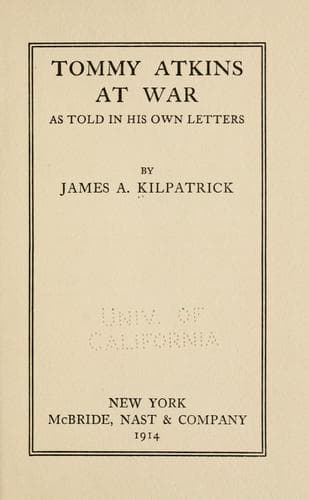
Tommy Atkins at War: As Told in His Own LettersKilpatrick, James Alexander
History
Tommy Atkins at War: As Told in His Own Letters
Kilpatrick, James Alexander
Great Britain. Army -- Military life; World War, 1914-1918
A sergeant of the Coldstream Guards, in an account given to the _Evening
News_, speaks of the death of Captain Windsor Clive. "We were sorry to
lose Captain Clive, who," he says, "was a real gentleman and a soldier.
He was knocked over by the bursting of a shell, which maddened our
fellows I can tell you." The utmost anger was also aroused in the men of
the Lancaster Regiment by the death of Colonel Dykes. "Good-by, boys,"
he exclaimed as he fell; and "By God, we avenged him," said one of the
"boys" in describing the fight.
Many instances are given of the devotion shown by the soldiers in saving
their officers. Private J. Ferrie, of the Royal Scots Fusiliers, wounded
while defending a bridge at Landrecies, tells in the _Glasgow Herald_
how Sergeant Crop rescued Lieutenant Stephens, who had been badly hit
and must otherwise have fallen into the enemy's hands: "The sergeant
took the wounded lieutenant on his back, but as he could not crawl
across the bridge so encumbered he entered the water, swam the canal,
carried the wounded man out of line of fire, and consigned him to the
care of four men of his own company. Of a platoon of fifty-eight which
was set to guard the bridge only twenty-six afterwards answered to the
roll call."
On the other hand, there are many records of the tremendous risks taken
by officers to rescue wounded men. Private J. Williams, Royal Field
Artillery, had two horses shot under him and was badly injured "when the
major rushed up and saved me." "I was lying wounded when an artillery
major picked me up and took me into camp, or I would never have seen
England again," writes Lance-Corporal J. Preston, Inniskilling
Fusiliers. Lieutenant Sir Alfred Hickman was wounded in the shoulder
while rescuing a wounded sergeant under heavy fire. How another disabled
man was brought in by Lieutenant Amos, is told by Private George
Pringle, King's Own Scottish Borderers. "Several of us volunteered to do
it," he says, "but the lieutenant wouldn't hear of anybody else taking
the risk." Captain McLean, Argyll and Sutherland Highlanders, saved one
of his men under similar circumstances. All the letters are full of
praise of the officers who, in the words of Private James Allan, Gordon
Highlanders, "seem to be mainly concerned about the safety of their men,
and indifferent to the risks they take upon themselves."
Every Tommy knows he is being finely led. The officers are a constant
source of inspiration and encouragement. Private Campbell, Irish
Fusiliers, writes:
"Lieutenant O'Donovan led us all the time, and was himself just where
the battle was hottest. I shall never forget his heroism. I can see him
now, revolver in one hand and sword in the other. He certainly accounted
for six Germans on his own, and inspired us to the effort of our lives.
He has only been six months in the service, is little more than a boy,
but the British Army doesn't possess a more courageous officer."
Public-domain text, read in full here on John Shaqi.
Reviews
Reviews
No reviews yet
Be the first to share your thoughts on this work.
Join the Discussion
Join the discussion
Sign in to leave a comment or review.
Sign InorCreate an account