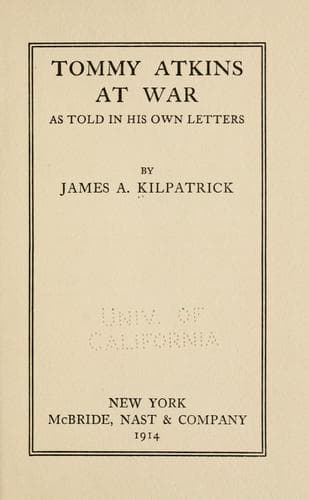
Tommy Atkins at War: As Told in His Own LettersKilpatrick, James Alexander
History
Tommy Atkins at War: As Told in His Own Letters
Kilpatrick, James Alexander
Great Britain. Army -- Military life; World War, 1914-1918
The same sense of order and method also struck another Frenchman, who
speaks of the "amazing Englishmen," who carry everything with them, and
are never in want of anything, not even of sleep!
Certainly there is much truth in these tributes to the British military
organization, but that is another story and for another chapter. The
opinion of an English cavalry officer, however, may be quoted as to the
relative merits of the French and English horses. "The French horses,"
he writes, "are awful. They look after them so badly. They all say,
'What lovely horses you have,' to us, and they do look fine beside
theirs, but we look after ours so well. We always dismount and feed them
on all occasions with hay and wheat found on the farms and in stacks in
the fields, also clover. The French never do."
As a result of these observations the French appear to have been
applying themselves to the study of the British fighting force. "I know
for a fact," says Trooper G. Douglas, "that French officers have been
moving amongst us studying our methods. The French Tommies try to copy
us a lot, and they like, when they have time, to stroll into our lines
for a chat or a game; but it's precious little time there is for that
now."
But it is in character and temperament that the chief differences of the
allies lie. "Brigadier" Mary Murray, who went to the front with other
members of the Salvation Army, records a conversation she had with a
French soldier over a cup of coffee. "Ah," he said, "we lose heavily, we
French. We haven't the patience of the English. They are fine and can
wait: we must rush!" And yet Tommy Atkins can do a bit of rushing too.
Private R. Duffy, of the Rifle Brigade, sends home a lively account of
the defense of the Marne in which a mixed force of British and French
was engaged. The object to be achieved was to drive back the Germans who
were attempting to cross the river. "About half a mile from the banks,"
writes Duffy, "we came out from a wood to find a French infantry
battalion going across in the same direction. We didn't want to be
behind, so we put our best foot forward, and one of the most exciting
races you ever saw followed. We got in first by a head, as you might
say, and we were just in time to tackle a mob of Germans heading for the
crossing in disorder. We went at them with the bayonet, but they didn't
seem to have the least heart for fighting. Some of them flung themselves
in the stream and tried to swim to safety, but they were heavily
accoutered and worn out so they didn't go very far. Of about three
hundred men who tried this not more than half a dozen succeeded in
reaching the other bank."
Public-domain text, read in full here on John Shaqi.
Reviews
Reviews
No reviews yet
Be the first to share your thoughts on this work.
Join the Discussion
Join the discussion
Sign in to leave a comment or review.
Sign InorCreate an account