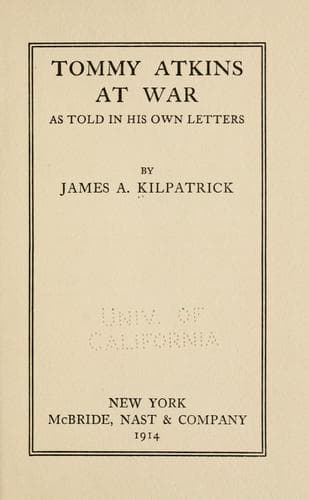
Tommy Atkins at War: As Told in His Own LettersKilpatrick, James Alexander
History
Tommy Atkins at War: As Told in His Own Letters
Kilpatrick, James Alexander
Great Britain. Army -- Military life; World War, 1914-1918
Having shown what the British soldier thinks of the French as fighting
men, it is pleasant to turn to our Ally's opinion of Tommy Atkins. Here
the letters deal in superlatives. M. Duchene, French master at
Archbishop Holgate's School, York, who was wounded with his regiment at
Verdun, writes in glowing terms of his comrades' praise. "Ah, those
English soldiers!" he says. "In my regiment you only hear such
expressions as _'Ils sont magnifiques,' 'Ils sont superbs,' 'Quels
soldats!'_ No better tribute could be given." Another Frenchman with the
army of the Republic is stirred into this eulogy in a letter to a friend
in England: "How fine they are, how splendidly they behave, these
English soldiers! In their discipline and their respect for their
officers they are magnificent, and you will never know how much we have
applauded them."
Another Frenchman, acting as interpreter with a Scottish regiment,
relates with amazement how the Highlanders go into action, "as if they
were going to a picnic, with laughing eyes and, whenever possible, with
a cigarette between their lips. Their courage is a mixture of
imperturbability and tenacity. One must have seen their immovable calm,
their heroic sang-froid, under the rain of bullets to do it justice."
Then he goes on to describe how a handful of Scots were selected to hold
back a large body of Germans in a village to enable the main body of the
British to retire in good order. They took up a position in the first
house they came to and fired away at the invaders, who rained bullets on
the building. Some of the gallant little party fell, but the others kept
up the fight. Then there came a pause in the attack, the German fire
ceased, the enemy was seeking a more sheltered position. During this
brief respite the sergeant in command of the Scots surveyed the building
they had entered. It was a small grocer's shop, and on an upper shelf he
found a few packets of chocolate. "Here, lads," he shouted, "whoever
kills his man gets a bit o' this." The firing began again, and as each
marksman succeeded, the imperturbable Scot shouted "Got him," and handed
over the prize amid roars of laughter. "Alas," comments the narrator,
"there were few prize-winners who lived to taste their reward."
The same eulogist, whose narrative was obtained by Reuter's
correspondent, also speaks of the fastidious Scot's preoccupations. He
has two--to be able to shave and to have tea. "No danger," the Frenchman
declares, "deters them from their allegiance to the razor and the
teapot. At ----, in the department of the Nord, I heard a British officer
of high rank declare with delicious calm between two attacks on the
town: 'Gentlemen, it was nothing. Let's go and have tea.' Meanwhile his
men took advantage of the brief respite to crowd round the pump, where,
producing soap and strop, they proceeded to shave minutely and
conscientiously with little bits of broken glass serving as mirrors."
Public-domain text, read in full here on John Shaqi.
Reviews
Reviews
No reviews yet
Be the first to share your thoughts on this work.
Join the Discussion
Join the discussion
Sign in to leave a comment or review.
Sign InorCreate an account