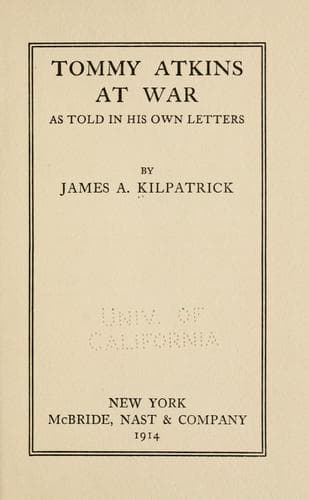
Tommy Atkins at War: As Told in His Own LettersKilpatrick, James Alexander
History
Tommy Atkins at War: As Told in His Own Letters
Kilpatrick, James Alexander
Great Britain. Army -- Military life; World War, 1914-1918
"The object of the great proportion of artillery the Germans employ is
to beat down the resistance of their enemy by a concentrated and
prolonged fire, and to shatter their nerve with high explosives before
the infantry attack is launched. They seem to have relied on doing this
with us; but they have not done so, though it has taken them several
costly experiments to discover this fact. From the statements of
prisoners, indeed, it appears that they have been greatly disappointed
by the moral effect produced by their heavy guns, which, despite the
actual losses inflicted, has not been at all commensurate with the
colossal expenditure of ammunition which has really been wasted. By this
it is not implied that their artillery fire is not good. It is more than
good; it is excellent. But the British soldier is a difficult person to
impress or depress, even by immense shells filled with high explosives
which detonate with terrific violence and form craters large enough to
act as graves for five horses. The German howitzer shells are 8 to 9
inches in caliber, and on impact they send up columns of greasy black
smoke. On account of this they are irreverently dubbed 'Coal-boxes,'
'Black Marias,' or 'Jack Johnsons' by the soldiers. Men who take things
in this spirit, are, it seems, likely to throw out the calculations
based on the loss of _moral_ so carefully framed by the German military
philosophers."
Every word of this admirable official message is borne out by the men's
own version of their experiences of artillery fire. "At first the din is
terrific, and you feel as if your ears would burst and the teeth fall
out of your head," writes one of the West Kents, "but, of course, you
can get used to anything, and our artillerymen give them a bit of hell
back, I can tell you." "The sensation of finding myself among screaming
shells was all new to me," says Corporal Butlin, Lancashire Fusiliers,
"but after the first terrible moments, which were enough to unnerve
anybody, I became used to the situation. Afterwards the din had no
effect upon me." And describing an artillery duel a gunner declares: "It
was butcher's work. We just rained shells on the Germans until we were
deaf and choking. I don't think a gun on their position could have sold
for old iron after we had finished, and the German gunners would be just
odd pieces of clothing and bits of accouterment. It seems 'swanky' to
say so, but once you get over the first shock you go on chewing biscuits
and tobacco when the shells are bursting all round. You don't seem to
mind it any more than smoking in a hailstorm."
Public-domain text, read in full here on John Shaqi.
Reviews
Reviews
No reviews yet
Be the first to share your thoughts on this work.
Join the Discussion
Join the discussion
Sign in to leave a comment or review.
Sign InorCreate an account