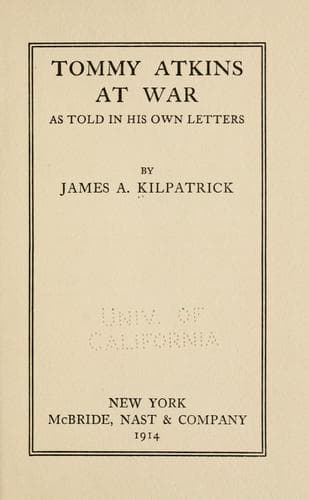
Tommy Atkins at War: As Told in His Own LettersKilpatrick, James Alexander
History
Tommy Atkins at War: As Told in His Own Letters
Kilpatrick, James Alexander
Great Britain. Army -- Military life; World War, 1914-1918
Smoking is the great consolation of the soldiers. They smoke whenever
they can, and the soothing cigarette is their best friend in the
trenches. "We can go through anything so long as we have tobacco," is a
passage from a soldier's letter; and this is the burden of nearly all
the messages from the front. "The fight was pretty hot while it lasted,
but we were all as cool as Liffy water, and smoked cigarettes while the
shells shrieked blue murder over our heads," is an Irishman's account of
the effect of the big German guns.
The noise of battle--especially the roar of artillery--is described in
several letters. "It is like standing in a railway station with heavy
expresses constantly tearing through," is an officer's impression of it.
A wounded Gordon Highlander dismisses it as no more terrible than a bad
thunderstorm: "You get the same din and the big flashes of light in
front of you, and now and then the chance of being knocked over by a
bullet or piece of shell, just as you might be struck by lightning."
That is the real philosophy of the soldier. "After all, we are may-be as
safe here as you are in Piccadilly," says another; and when men have
come unhurt out of infinite danger they grow sublimely fatalistic and
cheerful. An officer in the Cavalry Division, for instance, writes: "I
am coming back all right, never fear. Have been in such tight corners
and under such fire that if I were meant to go I should have gone by
now, I'm sure." And it is the same with the men. "Having gone through
six battles without a scratch," says Private A. Sunderland, of Bolton,
"I thought I would never be hit." Later on, however, he was wounded.
Though the artillery fire has proved most destructive to all ranks, by
far the worst ordeal of the troops was the long retreat in the early
stages of the war. It exhausted and exasperated the men. They grew angry
and impatient. None but the best troops in the world, with a profound
belief in the judgment and valor of their officers, could have stood up
against it. A statement by a driver of the Royal Field Artillery,
published in the _Evening News_, gives a vivid impression of how the men
felt. "I have no clear notion of the order of events in the long
retreat," he says; "it was a nightmare, like being seized by a madman
after coming out of a serious illness and forced towards the edge of a
precipice." The constant marching, the want of sleep, the restless and
(as it sometimes seemed to the men) purposeless backward movement night
and day drove them into a fury. The intensity of the warfare, the fierce
pressure upon the mental and physical powers of endurance, might well
have exercised a mischievous effect upon the men. Instead, however, it
only brought out their finest qualities.
Public-domain text, read in full here on John Shaqi.
Reviews
Reviews
No reviews yet
Be the first to share your thoughts on this work.
Join the Discussion
Join the discussion
Sign in to leave a comment or review.
Sign InorCreate an account