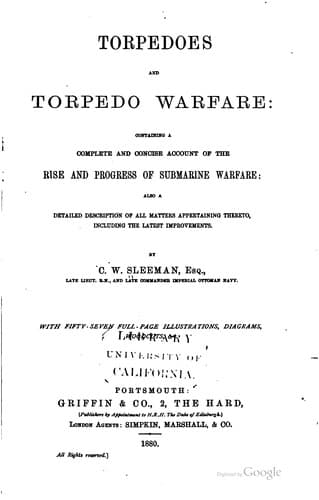
Torpedoes and Torpedo Warfare: Containing a Complete and Concise Account of the Rise and Progress of Submarine WarfareSleeman, Charles William
History
Torpedoes and Torpedo Warfare: Containing a Complete and Concise Account of the Rise and Progress of Submarine Warfare
Sleeman, Charles William
Torpedoes
_Cause of Failure of the Ottoman Fleet._--The cause of this repeated
neglect on the part of the Turkish fleet may be traced almost entirely
to the assumption (which in nine out of ten cases was an erroneous one)
on the part of the Naval Pashas and Beys that every Russian harbour,
etc., was a mass of submarine mines, and this in several instances
extending many miles to seaward.
So also, some of the many failures experienced by the Russians in
their numerous torpedo boat attacks, were due in a great measure
to an erroneous supposition on the part of the captain of the Russian
steamer, _Constantine_ (employed to convoy the torpedo boats), that
the Turks had defended the entrance, to a distance of some miles to
seaward, of their harbours, etc., and thus the torpedo boats were
dispatched to the attack some miles off the entrance, causing them,
owing to the darkness, to enter the harbour in which the Turkish
vessels were lying, in a very straggling manner. And to a similar
reason the failure of the Russians to capture Sulina, in the attack
made on that place in October, 1877, was principally owing to their not
daring to send their Popoffkas to attack from the sea.
One of the chief points of usefulness of an extensive and systematic
employment of submarine mines, will be to minimise the number of
vessels necessary for the protection of harbours, etc., thus enabling
a far larger number of ships to operate at sea against those of an
enemy, this especially applies to countries like England and America
possessing a large extent of seacoast, numerous harbours, rivers, etc.,
which it would be necessary to defend in the event of war.
_Science of Torpedo Warfare._--The science of defensive torpedo warfare
may be considered to consist of:--
1.--The arrangement of the mines in positions, such
that it would not be possible for a hostile vessel
attempting to force a passage into a harbour, etc.,
defended by such means, to pass more than one line of
them, without coming within the destructive radius of
some one or other of the remaining mines.
NOTE.--The difficulty of attaining the above effect, lies in the fact
that the destructive radius of a submarine mine, is considerably less
than the distance that must be maintained between them, to prevent
injury by concussion to the cases, circuit closers, electric cables,
etc., of such mines on the explosion of an adjacent one.
As an illustration of the above, take the case of a 500 lb. guncotton
submarine mine. Now the destructive radius of a sea-mine is found by
the formula R = [3rt](32 × C), where R is the destructive radius in
feet of a mine moored at its most effective depth, and C is the charge
(guncotton) in lbs.
Public-domain text, read in full here on John Shaqi.
Reviews
Reviews
No reviews yet
Be the first to share your thoughts on this work.
Join the Discussion
Join the discussion
Sign in to leave a comment or review.
Sign InorCreate an account