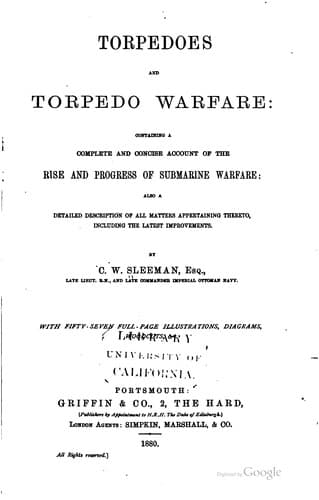
Torpedoes and Torpedo Warfare: Containing a Complete and Concise Account of the Rise and Progress of Submarine WarfareSleeman, Charles William
History
Torpedoes and Torpedo Warfare: Containing a Complete and Concise Account of the Rise and Progress of Submarine Warfare
Sleeman, Charles William
Torpedoes
In the above case R would be about 24 feet, which in so far as the
actual destruction of a ship is concerned, may be taken as correct,
but if injury to a vessel's engines, boilers, etc., be also taken into
consideration, and as the vessel would most probably be underweigh
on such an occasion, this would be a very vital and important
consideration, R would under those circumstances be more than doubled.
Now the necessary interval for safety between such mines, according
to torpedo authorities, is equal to 10 R, and should certainly be not
less than 8 R, which in this case would give about 200 feet, therefore
assuming the radius of destruction to be 50 feet, it is seen that there
would be under those conditions a clear undefended space of about 100
feet between each couple of 500 lb. mines in the same line.
2.--The combined arrangement of submarine mines with
forts and batteries, in such a manner, that every one
of the former shall be well covered by the guns of
the latter, and also that it would be impossible for
an enemy's ships to get within effective range of the
forts, or batteries, without moving over ground where
mines were laid.
NOTE.--This applies to the defence of the more important harbours,
etc., in which case the submarine mines (which would be chiefly
electrical ones) would only act as auxiliaries to the land defences. To
effectually carry out the above, there can be no question but that they
who plan the forts, etc., should also plan the systems of submarine
defence.
A harbour, river, etc., which it is necessary to protect by electrical
submarine mines, etc., and where no land defences exist, should have
its mines supported by a powerful ship or ships, as maybe thought
desirable.
_Success in Torpedo Warfare._--The two most important conditions
essentially necessary to the successful employment of torpedoes, both
offensive and defensive, are:--
1. CERTAINTY OF ACTION.
2. SIMPLICITY OF MANIPULATION.
Without the former this mode of Naval warfare is comparatively useless,
while without the latter the former condition is rarely obtained, more
especially in the case of offensive torpedoes.
Submarine mines are divided into separate classes, viz.:--
1. MECHANICAL MINES.
2. ELECTRICAL MINES.
_Mechanical Mines._--By this description of submarine mines, is meant
those whose charges are fired by mechanical means alone.
_Mechanical Mines in the American Civil War._--During the civil war
of America (1861-5), the Confederates depended almost entirely on
mechanical submarine mines for the protection of their harbours,
rivers, etc., and to this extensive use of such mines may be traced
nearly the whole of the Federal disasters afloat.
Public-domain text, read in full here on John Shaqi.
Reviews
Reviews
No reviews yet
Be the first to share your thoughts on this work.
Join the Discussion
Join the discussion
Sign in to leave a comment or review.
Sign InorCreate an account