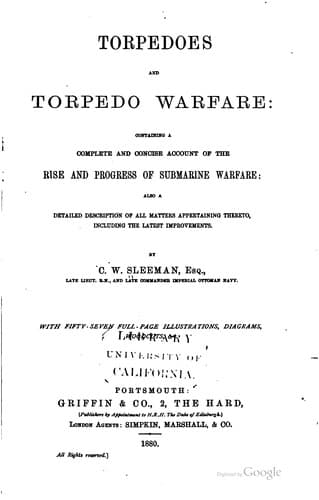
Torpedoes and Torpedo Warfare: Containing a Complete and Concise Account of the Rise and Progress of Submarine WarfareSleeman, Charles William
History
Torpedoes and Torpedo Warfare: Containing a Complete and Concise Account of the Rise and Progress of Submarine Warfare
Sleeman, Charles William
Torpedoes
_The Circuit._--In connection with the manipulation of batteries,
there is one important item to consider, viz. the _resistance_ in the
_circuit_, which may be divided into _external_ and _internal_.
_Resistances._--The _external_ resistance in practice is that which
exists in the conducting line, and the various instruments connected
with it.
The _internal_ resistance is that which exists in the battery itself.
All known conductors oppose a sensible _resistance_ to the passage
of an electric current, and the strength of the current, or in other
words, the quantity of electricity passing per second from one point to
another, when a constant difference of potentials is maintained between
them, depends on the _resistance_ of the wire on the conductor joining
them. A bad conductor does not let the electricity pass so rapidly as a
good conductor, that is, it offers more _resistance_.
Resistance in a wire of constant section and material is _directly_
proportional to the _length_, and _inversely_ proportional to the _area
of the cross section_.
The electrical resistance of a conductor must not be considered as
analogous to mechanical resistance, such as the friction which water
experiences in passing through a pipe, for this frictional resistance
_is not_ constant when different quantities of water are being forced
through the pipe, whereas electrical resistance is constant whatever
quantity of electricity be forced through the conductor.
_Application of Ohm's Law._--_Ohm's law_, which governs the strength of
the current, is expressed by the equation
C = E / R or R = E / C or E = CR.
Where C is the strength of the current;
E is the E.M.F. or difference of potentials;
and R is the resistance of the circuit. */
In words, _Ohm's law_ means that the strength of the current is
_directly_ proportional to the E.M.F., and _inversely_ proportional to
the resistance of the circuit.
As before stated, the resistance of the circuit consists of an
_external_ and an _internal_ resistance, therefore when these
resistances are separately considered, the equation C = E / R must be
converted into C = E / (_x_ + _r_), where _x_ is the external, and _r_
the internal, resistance.
The resistance of the battery or the _internal resistance_ depends on
the size of the plates and the distance between them, that is, it is
_directly_ proportional to the distance, and _inversely_ proportional
to the size.
The _electro-motive_ force of a battery is dependent generally on
the number of cells joined in _series_, and not on the _size_ of the
plates. The cells of a battery may be joined in two ways, as follows:--
1. In series: that is, by connecting the negative
element of one cell to the positive element of another,
and so on.
2. In multiple arc: that is, by connecting negative to
negative, and positive to positive; which is the same
as increasing the size of the cells.
Public-domain text, read in full here on John Shaqi.
Reviews
Reviews
No reviews yet
Be the first to share your thoughts on this work.
Elsewhere in the archive
Join the Discussion
Join the discussion
Sign in to leave a comment or review.
Sign InorCreate an account