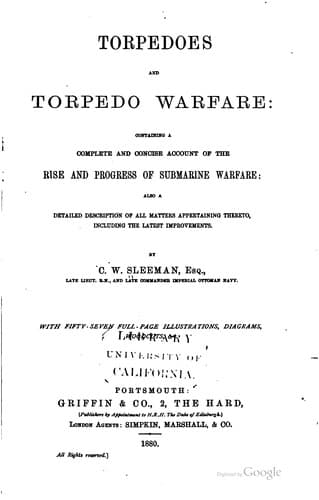
Torpedoes and Torpedo Warfare: Containing a Complete and Concise Account of the Rise and Progress of Submarine Warfare — John Shaqi
Torpedoes and Torpedo Warfare: Containing a Complete and Concise Account of the Rise and Progress of Submarine WarfareSleeman, Charles William
History
Torpedoes and Torpedo Warfare: Containing a Complete and Concise Account of the Rise and Progress of Submarine Warfare
Sleeman, Charles William
Torpedoes
_Multiple Cable._--This form of cable is employed in cases where it is
necessary to carry a large number of cables into the firing station,
&c. It consists of seven single cores formed into a strand, over which
a padding of hemp fibres is laid longitudinally, and over this again
is laid an armouring of sixteen (No. 9 B. W. G.) galvanised iron
wires, each one of which is covered with a layer of tarred tape put
on spirally with a twist of one revolution in 15 inches. The exterior
covering consists of two layers of hemp and composition, which is
laid on with a short twist, and in opposite directions. The external
diameter of this cable is 1-1/4 inch. Its weight in air and water is
78-25/112 cwt., and 45-32/112 cwt. respectively per nautical mile.
Its breaking strain is 135 cwt., and cost about £357 per nautical
mile. This form of cable is used in connection with a junction box,
from which the single armoured cables leading to the different mines
radiate, and is shown at Fig. 33.
_Circuit Closer Cable._--This cable, which connects the mine and
circuit closer, has been found to be subjected to exceptional wear and
tear, and therefore requires a special form of exterior protection. The
core of this cable is the same as the one described at page 41, also
it is covered with a similar padding of hemp, but instead of the iron
wires as in the case of the multiple cable, &c., nine strands, each of
which is composed of fourteen No. 22 Bessemer Steel Wires, are wound
on, each such strand being covered with hemp, which is put on with a
twist of one revolution in every 7-1/2 inches, the external covering
being the same as in other cables.
This form of armouring for an electric cable possesses the
qualifications of pliability, lightness, and great tensile strength.
Its weight in air is 52-106/112 cwt., and in water 28-4/112 cwt. per
nautical mile. Its breaking strain 65 cwt., and cost about £127 per
nautical mile.
_Single Core Unarmoured Cable._--This form of cable is used in a system
of defence by submarine mines to connect the detached works of a
maritime fortress, &c., for the purpose of telegraphing.
It consists of the ordinary service core, over which are laid two
servings of tarred hemp, put on spirally. The weight of this cable in
air is 4-13/112 cwt., and in water 1-36/112 cwt. per nautical mile; its
breaking strain is 7-1/2 cwt., and its cost per nautical mile is about
£35.
_Special Cables._--In firing electrical submarine mines by means of
cross bearings, a special cable is employed. As a general rule there
would be three lines of mines placed to converge on one of the stations.
Each of these lines would be provided with a conducting wire in
connection with the firing arrangements, while one line of wire in
connection with the firing station would be required for telegraphing.
For the purpose in question a four cored cable is used.
Public-domain text, read in full here on John Shaqi.
Reviews
Reviews
No reviews yet
Be the first to share your thoughts on this work.
Join the Discussion
Join the discussion
Sign in to leave a comment or review.
Sign InorCreate an account