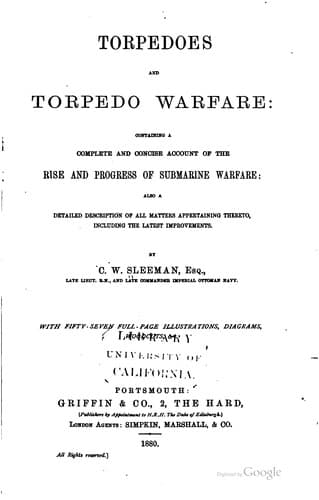
Torpedoes and Torpedo Warfare: Containing a Complete and Concise Account of the Rise and Progress of Submarine WarfareSleeman, Charles William
History
Torpedoes and Torpedo Warfare: Containing a Complete and Concise Account of the Rise and Progress of Submarine Warfare
Sleeman, Charles William
Torpedoes
_Land Service Cable._--The cable employed for this service consists
of a core formed similar to that of the multiple cable, described at
page 41; over which is laid a padding of hemp, and finally two servings
of tarred hemp laid spirally in opposite directions are wound on. Its
weight in air is 16 cwt., and in water 4-50/112 cwt. per nautical mile.
Its breaking strain 17-1/2 cwt., and cost per nautical mile about £137.
_Sea Service Cable._--This consists of a similar core to the land
service cable, and padding of hemp, over which is laid an armouring
of fifteen No. 13 galvanised iron wires, each one being covered with
tarred tape, and finally the ordinary servings of tarred hemp. Its
weight in air is 49-101/112 cwt., and in water 25-109/112 cwt. per
nautical mile. Its breaking strain 65-100/112 cwt., and cost per
nautical mile about £202.
When frictional electricity is used to fire high tension fuzes, it has
been found by experiment that if several lines of insulated cables
are laid in the same trench for a few hundred yards, the inductive
effect of the electrical charge generated by a frictional machine is so
great that its discharge through one cable is sufficient not only to
fire the fuze in immediate connection with it, but by induction every
other fuze in connection with the remaining wires laid in the trench.
And this effect equally occurs when the electric cables are some feet
apart, provided they run parallel for a few hundred yards, and whether
the shore ends of the cables, the fuzes in connection with which are
not intended to be fired, are insulated, or put directly to earth,
the connections beyond the fuzes being to earth, or even insulated,
provided a very few yards of conductor exist beyond the fuze.
The length of wire which it is necessary to use between the mine
and its circuit closer would be quite sufficient for the purpose of
effecting ignition by induction. With platinum wire fuses there is no
danger whatever of the above happening, nor in the case of high tension
fuzes is there so much danger of ignition by induction, when a constant
instead of a frictional electric battery is used to generate the
current.
Another mode of protecting an insulated cable is to place it, as it
were, in the core of a hempen cable. In forming the rope on the cable,
great care is necessary to prevent any serious amount of torsion,
or tension coming on the insulated wire, either of which would most
assuredly result in injury to the cable. This form of cable might in
connection with obstructions, &c., be of great use, as on account of
its closely resembling an ordinary rope, it would be very unlikely to
excite suspicion, and so would most probably be cut, the result of
which, by previous arrangement, would be an explosion of a mine, or by
means of a galvanometer, &c., an indication that the obstructions, &c.,
were being interfered with.
Public-domain text, read in full here on John Shaqi.
Reviews
Reviews
No reviews yet
Be the first to share your thoughts on this work.
Join the Discussion
Join the discussion
Sign in to leave a comment or review.
Sign InorCreate an account