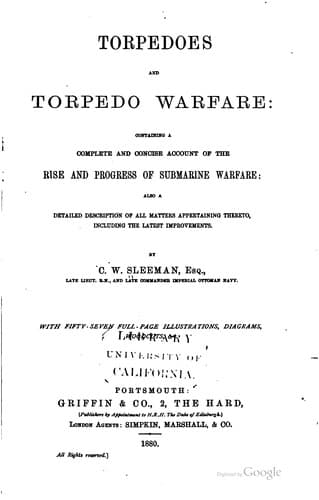
Torpedoes and Torpedo Warfare: Containing a Complete and Concise Account of the Rise and Progress of Submarine WarfareSleeman, Charles William
History
Torpedoes and Torpedo Warfare: Containing a Complete and Concise Account of the Rise and Progress of Submarine Warfare
Sleeman, Charles William
Torpedoes
And make a band of four fine tinned copper wires, and bind them tightly
side by side round the joint, covering the whole length of the scarf,
and then solder the band and joint solidly together.
Then make another band of four fine tinned copper wires and bind them
round the joint in the same manner as before, but extending about a
quarter of an inch beyond each end of the other binding wire, the
parts only of this second binding which project beyond the end of the
first binding are to be soldered, so that the centre part remains loose
and may keep up a connection between the two ends by forming a spiral
between them in the event of the scarf giving way and the two ends of
the conductor separating slightly.
This form of joint is called the "spring" joint.
The finished joint should be washed with spirit of wine and brushed, so
as to take away all particles of soldering flux, and to avoid oxidation
of the wire. The washed joint should then be dried with a piece of
cloth and exposed to the flame of a spirit lamp to dry it thoroughly.
A cable conductor ought never to be jointed with the help of soldering
acid, but with that of resin, sal ammoniac, or borax only, so that any
chance oxidation, and consequently destruction, of the conducting wire
may be avoided.
There are other modes of jointing conductors, such as the twisting and
scale joint, but the foregoing method will sufficiently explain this
part of electric cable work.
_The Formation of a Joint in an India rubber Insulated Cable._--In
making a joint in any insulated cable, the very greatest care must be
taken to keep the hands, tools, and materials clean and dry.
Remove the felt for about twelve inches from each end of the core by
soaking it with mineral naphtha and then rubbing it off clean with the
file-card. The cleaned surface sear with a red-hot iron, to burn off
all remaining fibres of the felt. Wash these seared ends clean with
naphtha.
Then cut off about four inches of the insulating material (taking
care never to cut at right angles to the conducting wire for fear of
injuring it) so as to leave enough of the conductor bare to join and
solder in the manner described at page 47.
After the conductor is jointed and soldered, clean again the seared
parts of the insulator with the glazed side of the squares of cloth
moistened with mineral naphtha, so as to leave a clean adhesiveness
only; taper again the insulating material down to the conductor for
about two inches on each side of the conductor-joint with a pair of
curved and very clean scissors.
The tapering must be completed in such slanting way that the different
layers of the dielectric are so far exposed as to enable a secure
laying on of the new jointing material.
India rubber core consists chiefly of three layers of insulating
material: the first layer next to the strand is called the pure or
brown; the second layer is the white or separating; the third layer is
the light red or jacket rubber.
Public-domain text, read in full here on John Shaqi.
Reviews
Reviews
No reviews yet
Be the first to share your thoughts on this work.
Join the Discussion
Join the discussion
Sign in to leave a comment or review.
Sign InorCreate an account