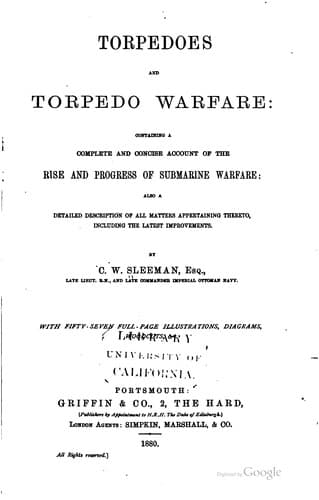
Torpedoes and Torpedo Warfare: Containing a Complete and Concise Account of the Rise and Progress of Submarine WarfareSleeman, Charles William
History
Torpedoes and Torpedo Warfare: Containing a Complete and Concise Account of the Rise and Progress of Submarine Warfare
Sleeman, Charles William
Torpedoes
Coat the conductor with a pure (brown) rubber tape tightly laid on
in a spiral form, commencing at the spot where the separator (white)
ends, across the corresponding place on the opposite side of the joint
and back again in a contrary direction. The ends are fastened down by
pressing a clean, heated searing-iron or a heated knife on them. By
doing so the band will stick; the remaining portions of the band to be
cut off with the scissors.
Lay on tightly the separating india rubber tape in the same manner, but
beginning where the jacket or outer layer of rubber ends. One lap will
be sufficient.
Complete the insulation by lapping on tightly two layers of red india
rubber tape: the last lap must cover each end of the core to four
inches on each side of the conductor-joint, or extend to the searing or
tackiness, but not beyond it.
Lay on three tight bindings of the cloth tapes, all in the same
direction, care being taken to avoid wrinkles. The ends of the cloth
tapes are cemented down with a thin coating of india rubber cement.
Immerse the joint in the jointing-bath at 150° to 200° F. and gradually
raise the heat so that in half an hour the temperature will be 320° F.,
at which temperature keep the joint for twenty minutes: then take it
out and let it cool in the open air.
_The Formation of a Joint in a Gutta percha Insulated Cable._--Having
jointed the conducting wires in the manner described at page 47, clean
and dry the joint well and cover the bare conductor with a thin layer
of compound. This is best done by heating a small stick of compound to
nearly its melting point, and rubbing it over the bare conductor, which
has been previously heated with the flame of a spirit-lamp.
Heat the gutta percha covering of both ends gently until it is quite
soft, without, however, causing it to bubble or burn. Draw, then, with
the fingers, the gutta percha coverings of both ends down, tapering
them off until they meet in the middle of the joint; heat them
sufficiently to make them adhere together.
Apply a layer of compound on the tapered-off gutta percha in the same
manner as described for coating the bare conductor, and cover it with
a first coating of gutta percha sheet to about half the thickness
necessary to finish the joint. This is done by heating a small sheet
of gutta percha, of about one-eighth of an inch in thickness, until it
is quite soft, and by pressing it in that state round the joint to the
required size; the greatest care to be taken to expel all the air.
The projecting lips are then cut off with a pair of curved scissors.
The seam thus produced is to be rubbed with a hot iron until it is
completely closed and the joint well rounded off.
Apply another layer of compound and a second layer of gutta percha
in exactly the same manner as described for the first layer; care,
however, is to be taken to get the seam in this second layer of gutta
percha not over, but as nearly as possible right opposite to, the seam
in the layer underneath.
Public-domain text, read in full here on John Shaqi.
Reviews
Reviews
No reviews yet
Be the first to share your thoughts on this work.
Join the Discussion
Join the discussion
Sign in to leave a comment or review.
Sign InorCreate an account