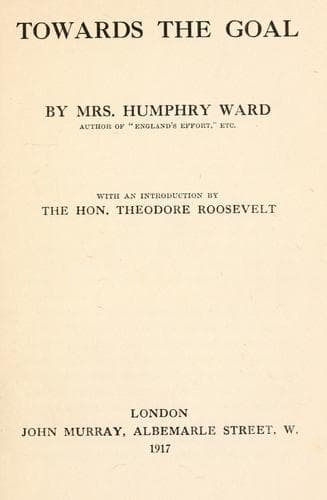
World War, 1914-1918 -- Campaigns -- Western Front; World War, 1914-1918 -- Personal narratives
So far my recollections of March 3rd. But this is now April 26th, and
all the time that I have been writing these recollections, thought has
been leaping forward to the actual present--to the huge struggle now
pending between Arras and Rheims--to the news that comes crowding in,
day by day, of the American preparations in aid of the Allies--to all
that is at stake for us and for you. Your eyes are now turned like ours
to the battle-line in France. You triumph--and you suffer--with us!
No. 6
_May 3rd_, 1917.
DEAR MR. ROOSEVELT,--My last letter left me returning to our village
lodgings under the wing of G.H.Q. after a memorable day on the Somme
battle-fields. That night the talk at the Visitors' Château, during and
after a very simple dinner in an old panelled room, was particularly
interesting and animated. The morning's newspapers had just arrived from
England, with the official communiques of the morning. We were pushing
nearer and nearer to Bapaume; in the fighting of the preceding day we
had taken another 128 prisoners; and the King had sent his
congratulations to Sir Douglas Haig and the Army on the German
withdrawal under "the steady and persistent pressure" of the British
Army "from carefully prepared and strongly fortified positions--a
fitting sequel to the fine achievements of my Army last year in the
Battle of the Somme." There was also a report on the air-fighting and
air-losses of February--to which I will return.
It was, of course, already obvious that the German retreat on the Somme
was not--so far--going to yield us any very large captures of men or
guns. Prisoners were indeed collected every day, but there were no
"hauls" such as, little more than a month after this evening of March
3rd, were to mark the very different course of the Battle of Arras.
Discussion turned upon the pace of the German retreat and the possible
rate of our pursuit. "Don't forget," said an officer, "that they are
moving over good ground, while the pursuit has to move over bad
ground--roads with craters in them, ground so pitted with shell-holes
that you can scarcely drive a peg between them, demolished bridges,
villages that give scarcely any cover, and so on. The enemy has his guns
with him; ours have to be pushed up over the bad ground. His
machine-guns are always in picked and prepared positions; ours have to
be improvised."
Public-domain text, read in full here on John Shaqi.
Reviews
Reviews
No reviews yet
Be the first to share your thoughts on this work.
Join the Discussion
Join the discussion
Sign in to leave a comment or review.
Sign InorCreate an account