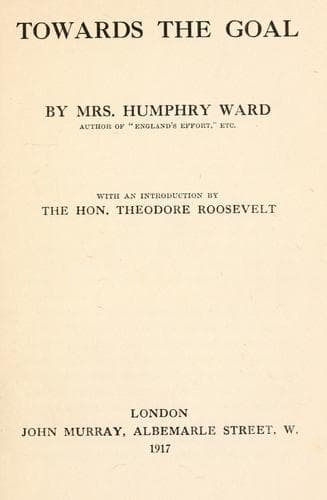
World War, 1914-1918 -- Campaigns -- Western Front; World War, 1914-1918 -- Personal narratives
And also--"Don't forget the weather!" said another. Every misty day--and
there were many in February--was very skilfully turned to account.
Whenever the weather conditions made it impossible to use the eyes of
our Air Service, men would say to each other on our side, "He'll go back
a lot to-day!--somewhere or other." But in spite of secrecy and fog, how
little respite we had given him! The enemy losses in casualties,
prisoners, and stores during February were certainly considerable; not
to speak of the major loss of all, that of the strongly fortified line
on which two years of the most arduous and ingenious labour that even
Germany can give had been lavished. "And almost everywhere," writes an
eye-witness, "he was hustled and harried much more than is generally
known." As you go eastward, for instance, across the evacuated ground
you notice everywhere signs of increasing haste and flurry, such as the
less complete felling of trees and telegraph posts. It was really a fine
performance for our infantry and our cavalry patrols, necessarily
unsupported by _anything like our full artillery strength,_ to keep up
the constant pressure they did on an enemy who enjoyed almost the full
protection of his. It was dreadful country to live and fight in after
the Germans had gone back over it, much worse than anything that troops
have to face after any ordinary capture of an enemy line.
The fact is that old axioms are being everywhere revised in the light of
this war. In former wars the extreme difficulty of a retreat in the face
of the enemy was taken for granted. But this war--I am trying to
summarise some first-hand opinion as it has reached me--has modified
this point of view considerably.
We know now that for any serious attack on an enemy who has plenty of
machine-guns and plenty of successive well-wired positions a great mass
of heavy and other artillery is absolutely indispensable. And over
ground deliberately wrecked and obstructed such artillery _must_ take
time to bring up. And yet--to repeat--how rapidly, how "persistently"
all difficulties considered, to use the King's adjective, has the
British Army pressed on the heels of the retreating enemy!
None of the officers with whom I talked believed that anything more
could have been done by us than was done. "If it had been we who were
retreating," writes one of them, "and the Germans who were pursuing, I
do not believe they would have pushed us so hard or caused us as much
loss, for all their pride in their staff work."
Public-domain text, read in full here on John Shaqi.
Reviews
Reviews
No reviews yet
Be the first to share your thoughts on this work.
Join the Discussion
Join the discussion
Sign in to leave a comment or review.
Sign InorCreate an account