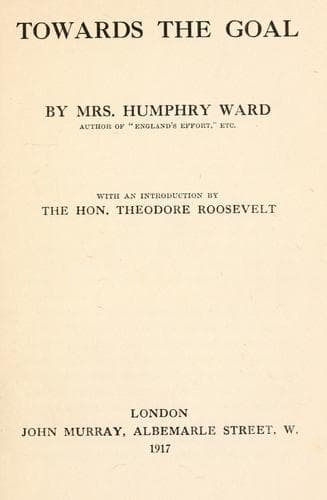
World War, 1914-1918 -- Campaigns -- Western Front; World War, 1914-1918 -- Personal narratives
This combination of the Curé's written and spoken account is as close to
the facts as I can make it. His narrative as he gave it to me, of what
he had seen and felt, was essentially simple, and, to judge from the
French official reports, with which I have compared it, essentially
true. There are some discrepancies in detail, but nothing that matters.
The murder of M. Odent, of the other hostages, of the civilians placed
in front of the German troops, and of four or five other victims; the
burning out by torch and explosive of half a flourishing town, because
of a discreditable mistake, the fruit of panic and passion,--these
crimes are indelibly marked on the record of Germany. She has done worse
elsewhere. All the same, this too she will never efface. Let us imagine
such things happening at Guildford, or Hatfield, or St. Albans!
We parted with M. le Curé just in time to meet a pleasant party of war
correspondents at the very inn, the Hôtel du Cerf, which had been the
German Headquarters during the occupation. The correspondents were on
their way between the French Headquarters and the nearest points of the
French line, Soissons or Compiègne, from whose neighbourhood every day
the Germans were slowly falling back, and where the great attacks of the
month of April were in active preparation. Then, after luncheon, we
sallied out into the darkening afternoon, through the Forest of
Ermenonville, and up to the great plateau, stretching north towards
Soissons, southwards towards Meaux, and eastwards towards the Ourcq,
where Maunoury's Sixth Army, striking from Paris and the west, and the
English Army, striking from the south--aided by all the gallant French
line from Château Thierry to the Grand Couronné--dealt that staggering
blow against the German right which flung back the German host, and,
weary as the way has been since, weary as it may still be, in truth,
decided the war.
But the clouds hang lower as we emerge on the high bare plain. A few
flakes--then, in a twinkling, a whirling snow-storm through which we can
hardly see our way. But we fight through it, and along the roads every
one of which is famous in the history of the battle. At our northernmost
point we are about thirty miles from Soissons and the line. Columns of
French infantry on the march, guns, ammunition, stores, field kitchens,
pass us perpetually; the motor moves at a foot's pace, and we catch the
young faces of the soldiers through the white thickened air. And our
most animated and animating companion, Monsieur P----, with his
wonderful knowledge of the battle, hails every landmark, identifies
every farm and wood, even in what has become, in less than an hour, a
white wilderness. But it is of one village only, of these many whose
names are henceforth known to history, that I wish to speak--the
village of Vareddes. In my next letter I propose to tell the ghastly
story of the hostages of Vareddes.
No. 8
_May 17th_, 1917.
Public-domain text, read in full here on John Shaqi.
Reviews
Reviews
No reviews yet
Be the first to share your thoughts on this work.
Join the Discussion
Join the discussion
Sign in to leave a comment or review.
Sign InorCreate an account