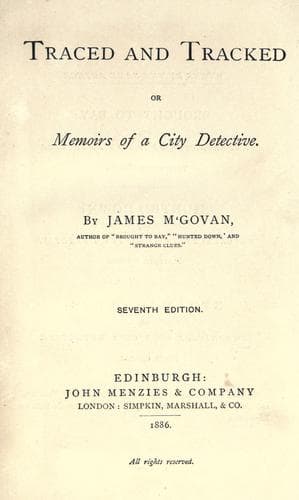
Traced and Tracked; Or, Memoirs of a City DetectiveM'Govan, James
General
Traced and Tracked; Or, Memoirs of a City Detective
M'Govan, James
Detective and mystery stories; Edinburgh (Scotland) -- Fiction
“Yes; I was told by one who knows, but wanted to keep it quiet, that
the tailor was seen coming out of your bakehouse window at about one
o’clock in the morning.”
“And you never told me!” cried Coglin, reproachfully.
“I can’t tell you even yet; I only say I think it,” said Burfoot,
cautiously.
Coglin was conquered at last, and he and Burfoot left the spot
arm-in-arm and fast friends for life. Some of these facts came out
long after, when I had the tailor in my hands on another charge, and
some were given me by Coglin himself. He is in business still, and
prospering in a town on the opposite side of the Forth, and Burfoot
often goes through to spend a few days there with his firm friend,
golfing on a nice links near the place. As he knows all about the
baker’s misconceptions and plans for his punishment, and the names
are all changed here, I have decided that the giving of the details
can do no harm now, and may at the same time teach those seeking
revenge that it is possible for punishment intended for another to
drop very neatly on to their own shoulders.
ONE LESS TO EAT.
The number of mysterious disappearances in great cities can be
calculated upon with almost the same certainty as the death rate. A
very few of these are accounted for; a body is found and identified,
or a man vanished is found to have been in difficulties, and it
is shrewdly or rashly surmised that he has fled to escape the
consequences; but the majority of the cases pass into the great
unknown, so far as either police or public are concerned.
No. 7 Hill Place, at the South Side, leads to a back court of
wretched dwellings occupied by the very poor. At the west side of
that court is a block or “land” of houses which are now rather worse
than they were at the time of which I write, for a theatre has been
built up against the back windows, almost shutting out the light
of day from one side of the building. At that time the top windows
looked into an auctioneer’s yard, and, having a better share of light
than the lower flats, were considered rather respectable abodes for
working men. In one of these lived George Mossman, a journeyman
baker. The house consisted of two rooms, and had been at one time
very nicely furnished; but on the Saturday night of which I write the
two places were almost empty, for Mossman had been off work for many
months with a poisoned hand, which refused to heal, and so kept him
and his wife and family “living on the furniture.” At first Mossman,
who was of a cheery, blithe disposition, had made a joke of his
disabled hand, and laughingly declared that he had “an income in his
hand, but nane in his pouch;” but as month after month went past, and
the hand showed no signs of healing, joking was hushed on his lips.
Hunger, starvation, and perhaps death stared them in the face; for
Mossman shared the common horror of pauperism, and would have dropped
dead before he could have applied at the Poorhouse for a dole.
Public-domain text, read in full here on John Shaqi.
Reviews
Reviews
No reviews yet
Be the first to share your thoughts on this work.
Elsewhere in the archive
Join the Discussion
Join the discussion
Sign in to leave a comment or review.
Sign InorCreate an account