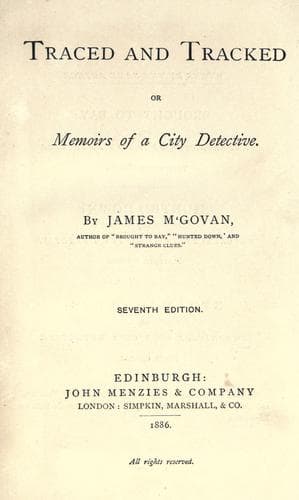
Traced and Tracked; Or, Memoirs of a City DetectiveM'Govan, James
General
Traced and Tracked; Or, Memoirs of a City Detective
M'Govan, James
Detective and mystery stories; Edinburgh (Scotland) -- Fiction
“A minister of the Gospel to descend to a mean theft like that!” he
said to himself. “I must call a meeting of the managers and report
the whole case.”
It happened to be the month of July, and there was a difficulty in
getting a quorum of the managers together, but at length Aikman was
promised a full meeting, which took place on the Wednesday following
in his own house. There, after shutting themselves in, and making
sure that no one could overhear, the four men considered the case
of the stolen bank note. Of course they were shocked at the implied
guilt of one whom they revered and trusted so much, but Aikman piled
up his facts in such a minute and positive manner, that even without
additional evidence there would have been little diversity of opinion
among them. At this stage, and when Aikman had scarcely concluded,
another of the managers quickly exclaimed—
“Why, Mr Morrison changed a £5 note with me yesterday.”
“Yesterday?” echoed another, to whom the minister owed a small sum.
“And he told me on Saturday that he had no money, and would not have
till next quarter day.”
“There! What did I say?” cried Aikman with triumphant energy. “Could
anything be clearer than that? I know for a fact that he has no
money—it is all eaten up long before it is paid to him by me; yet
there you have proof that near the end of the quarter he pays away
money, and that a £5 note. Have you the note yet?” he added to the
man who had received the payment.
He had, and would run and get it. A wiser plan would have been to
first make Mr Aikman describe the note put in the plate, and write
down its number, and then send for that received from the minister,
and compare the record with the note, but that was never thought of.
The other deacon had only half a street to traverse, and was back in
a few minutes with a crisp bank note. It was of the Bank of Scotland,
and nearly new. Mr Aikman snatched it from the bearer—opened it,
glanced at the device and the number, and then exclaimed—
“It’s a clear case! look at the number for yourselves, ‘7607’—the
very figures of the one I saw lying in the plate. I couldn’t help
reading them, for the note lay open, and I never forget anything.”
A painful silence followed. At length some one asked the question
which was uppermost in all their minds—What was to be done? They
could not pass over the robbery in silence, and yet it would be a
delicate and possibly a dangerous thing to charge a clergyman with
such a theft.
“Nothing dangerous about it,” said Aikman, brusquely. “I can swear
to the note being put in the plate, and the number, and the name of
the bank; also, that the minister was the only one near the plate
while I was absent for half a minute; and you can swear that he paid
away the note to you and got change. What’s to be done? Shall we ask
him to resign, demand the money back, or give him up to the police to
be dealt with as they think best?”
Public-domain text, read in full here on John Shaqi.
Reviews
Reviews
No reviews yet
Be the first to share your thoughts on this work.
Elsewhere in the archive
Join the Discussion
Join the discussion
Sign in to leave a comment or review.
Sign InorCreate an account