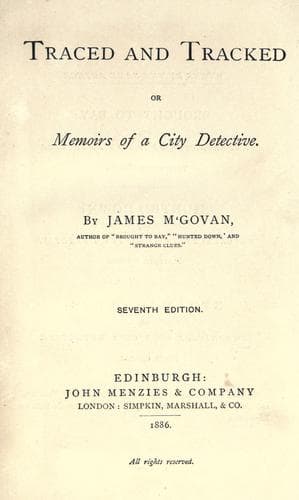
Traced and Tracked; Or, Memoirs of a City DetectiveM'Govan, James
General
Traced and Tracked; Or, Memoirs of a City Detective
M'Govan, James
Detective and mystery stories; Edinburgh (Scotland) -- Fiction
It was quite clear to all present which of these courses Mr Aikman
wished followed, and they unanimously decided that the most rigorous
course was necessary in dealing with such a criminal. Mr Aikman was
therefore deputed to lay the matter before the chief constable of the
town, who, however, happened to have a personal acquaintance with the
young clergyman, and a great liking for him as well, and not only
scouted the idea of him stealing the bank note, but strongly urged
Aikman to say nothing of the matter to his minister, whatever other
means he might employ for the recovery of the note.
Finding it impossible to move the deacon, the constable at length
compromised the matter by agreeing to go with Aikman to the
minister’s house—it was not a manse, but a little flat, up an outside
stair—and see if Mr Morrison had any explanation to offer. They found
the young clergyman at home by the bedside of his wife, who was
almost a confirmed invalid, and had been rather weaker than usual
for some days. The constable was moved at the sight of the young
preacher’s pale and concerned expression as he hung over the invalid,
but the deacon had no such qualms—he looked upon these as indications
of guilt, and would have blurted out the charge in hearing of the
sick wife but for a huge pinch on his arm by the constable, who at
the same time quietly nodded to Morrison, and invited him to speak
with them for a moment in the next room.
“There is some difficulty about that £5 note which you paid away on
Tuesday to Blackie, the grocer,” observed the constable, kindly;
while the deacon, as a duty he owed to society, steadily speared the
young preacher with his goggling eyes. “Would you mind saying where
you got the note?”
The righteous deacon had his reward, for the moment these words were
uttered, a startled look came to the worn features of the minister,
and his face flushed a deep crimson.
“I scarcely know myself,” he at length responded, with considerable
hesitation; “is it necessary that I should make that known? What has
happened? Is there anything wrong with it? Is it a forged note?”
“Oh, no; the note is good enough,” cried the deacon, sternly, still
using his spears liberally; “as good as any ever put out by the Bank
of Scotland. The lady who put it into the plate on Sunday was not
likely to have a forged note in her pocket.”
The young preacher started as if the deacon had run a knife into him.
He seemed petrified, breathless, and dumb with astonishment.
“I do not know what you mean, or what you are hinting at,” he at
length replied; “but I know that the note you speak of could not
possibly have been in any lady’s pocket on Sunday, seeing that it was
then lying in my desk here, in this house.”
“You’ll have to prove that,” derisively returned Aikman. “Where did
you get it, and when?”
Public-domain text, read in full here on John Shaqi.
Reviews
Reviews
No reviews yet
Be the first to share your thoughts on this work.
Elsewhere in the archive
Join the Discussion
Join the discussion
Sign in to leave a comment or review.
Sign InorCreate an account