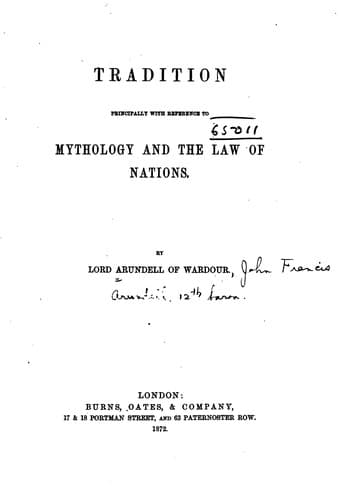
Tradition, Principally with Reference to Mythology and the Law of NationsArundell of Wardour, John Francis Arundell, Baron
Philosophy
Tradition, Principally with Reference to Mythology and the Law of Nations
Arundell of Wardour, John Francis Arundell, Baron
International law; Macdonell, George, 1780-1870; Mythology; Natural law; Tradition (Theology)
dissolution_?"--_From Père Lacordaire's "Conferences." Conf. 9 and
10._ (Tran. H. Langdon; Richardson, 1852.)
I should also wish M. Auguste Nicolas' "Etudes Philosophiques
sur le Christianisme"--particularly lib. I. chap. v., "Necessite
d'une revelation Primitive;" and lib. II. chap. iv., "Traditions
universelles"--to be read in connection with the following chapter.
I did not become acquainted with M. Nicolas until after the chapter
was concluded. I have, however, fulfilled my obligations in the
above extract from L'Abbe Lacordaire, which lies more _au fond_ of
my view than the chapters referred to in M. Nicolas. I also wish to
direct attention to a remarkable article in the _Home and Foreign
Review_, Jan. 1864, entitled "Classical Myths in relation to the
Antiquity of Man," signed F. A. P.
Tradition, in the sense in which we have just seen it used by
Lacordaire, in what we may call its widest signification, is not
limited to oral tradition, but may be termed the connection of
evidence which establishes the unity of the human race; and, with this
evidence, establishes the identity and continuity of its belief, laws,
institutions, customs, and manners (Manners, _vide_ Goguet's "Origin
of Laws," i. 327-329). The more closely the tradition is investigated,
the more thoroughly will it be found to attest a common origin, and the
more fully will its conformity with the scriptural narrative be made
apparent.
Now, although in all ages there have been men of great intellect who
have held to tradition, it may be stated as one of those truths,
_qui saute aux yeux_, and which will not be gainsaid, that the human
intellect has been throughout opposed to tradition, has been its most
constant adversary, equally when it was the tradition of a corrupt
polytheism, as when it was the tradition of uncontested truth; and so
active has been this antagonism, that the marvel is that anything of
primitive tradition should have remained.
Hence arose the divergence between religion and philosophy--a
divergence which, as it seems to me, is inexplicable from the point of
view of those who believe that, in the centuries which preceded the
coming of our Lord,[78] religion simply was not, had ceased to be;
unless we suppose that a tradition of the antagonism had survived,
which would still partially disclose how it came about that when
religion had ceased to be (_pro argumento_), or had become corrupt,
philosophy, which then (_ex hypothesi_) alone soared above the
intellect of the crowd, did not, and could not become a religion to
them, _infra_, pp. 142, 145, 146.
Public-domain text, read in full here on John Shaqi.
Reviews
Reviews
No reviews yet
Be the first to share your thoughts on this work.
Elsewhere in the archive
Join the Discussion
Join the discussion
Sign in to leave a comment or review.
Sign InorCreate an account