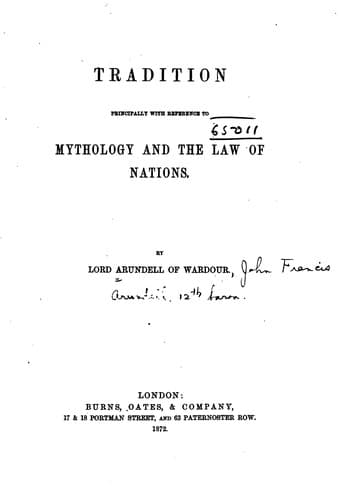
Tradition, Principally with Reference to Mythology and the Law of NationsArundell of Wardour, John Francis Arundell, Baron
Philosophy
Tradition, Principally with Reference to Mythology and the Law of Nations
Arundell of Wardour, John Francis Arundell, Baron
International law; Macdonell, George, 1780-1870; Mythology; Natural law; Tradition (Theology)
[78] Such appears to me to be the conclusion of Mr Allies in his
learned work ("The Formation of Christendom," ii. chap. viii.
57), "Universality of false worship in the most diverse
nations the summing up of man's whole history." I request
attention, however, to the following passage, at page 382,
which has an especial bearing upon my argument:--"No doubt the
Greek mind had lived and brooded for ages upon the remains
of original revelation, nor can any learning now completely
unravel the interwoven threads of tradition and reason so as
to distinguish their separate work. However, it is certain
that in the sixth century B.C., the Greeks were
without a hierarchy, and without a definite theology: not
indeed without individual priesthoods, traditionary rites,
and an existing worship, as well as certain mysteries which
professed to communicate a higher and more recondite doctrine
than that exposed to the public gaze. But in the absence of
any hierarchy ... a very large range indeed was given to the
mind, acting upon this shadowy religious belief, and re-acted
upon by it, to form their philosophy. The Greeks did not, any
more than antiquity in general, use the acts of religious
service for instruction by religious discourse. In other
words, there was no such thing as preaching among them. A
domain, therefore, was open to the philosopher, on which he
might stand without directly impeaching the ancestral worship,
while he examined its grounds, and perhaps _sapped its
foundations_. He was therein taking up a position which these
priests, the civil functionaries of religious rites, _scarcely
any longer_ retaining a spiritual meaning or a moral cogency,
had not occupied."
And the history of this antagonism seems to be, that the human
intellect has ever had, and now more confidently than ever, the aim
and ambition to substitute something better than the revelation of
primitive tradition, and the experiences of the human race.
It is quite conceivable that human life and human institutions might
have been arranged upon some scheme different from that of the divine
appointment; and although we may believe that any such scheme would
result in ultimate confusion and the final extinction of the human
race, it is still theoretically possible that the experiment might have
been made.[79]
Public-domain text, read in full here on John Shaqi.
Reviews
Reviews
No reviews yet
Be the first to share your thoughts on this work.
Elsewhere in the archive
Join the Discussion
Join the discussion
Sign in to leave a comment or review.
Sign InorCreate an account