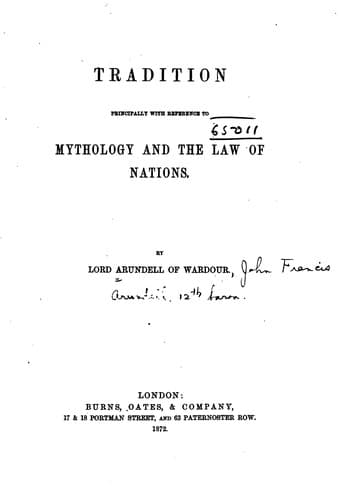
Tradition, Principally with Reference to Mythology and the Law of NationsArundell of Wardour, John Francis Arundell, Baron
Philosophy
Tradition, Principally with Reference to Mythology and the Law of Nations
Arundell of Wardour, John Francis Arundell, Baron
International law; Macdonell, George, 1780-1870; Mythology; Natural law; Tradition (Theology)
invention of men, we see that there exists two kinds of it--human
and sacred scripture. I understand by human scripture, that which
is considered by men as the expression of the ideas of a man; I
understand by sacred scripture that which is venerated by nations
as containing something more than the ideas of a man.... There are
in the world an innumerable quantity of books, nevertheless there
are but six of them which have been venerated by nations as sacred.
These are the 'Kings' of China, the Vedas of India, the Zend-Avesta
of the Persians, the Koran of the Arabs, the Law of the Jews, and
the Gospel. And at first sight I am struck with this rarity of
sacred writings. So many legislators have founded cities, so many
men of genius have governed the human understanding, and yet all
these legislators, all these men of genius, have not been able to
cause the existence of more than six sacred books upon earth!...
Every sacred book is a traditional book, it was venerated before
it existed, it existed before it appeared. The Koran, which is
the last of the sacred writings in the order of time, offers to
us a proof of this worthy of our thoughtful attention. Without
doubt, Mahommed relied upon pretended revelations; however, it
is clear to all those who read the Koran, that the Abrahamic
tradition was the true source of its power.... The same traditional
character shines upon each page of the Christian and Hebrew books;
we find it also in the Zend-Avesta, the Vedas, and the Kings of
the Chinese. Tradition is everywhere the mother of religion; it
precedes and engenders sacred books, as language precedes and
engenders scripture; its existence is rendered immovable in the
sacred books ... a sacred book is a religious tradition which has
had strength enough to sign its name.... The sacred writings are,
then, traditional; it is their first character. I add that they are
constituent, that is to say, they possess a marvellous power for
giving vitality and duration to empires. Strange to say, the most
magnificent books of philosophers have not been able to found, I do
not say a people, but a small philosophical society; and the sacred
writings, without exception, have founded very great and lasting
nations. Thus the Kings founded China, the Vedas India, &c.... Look
at Plato ... how is it that Plato has not been able to constitute,
I do not say a nation, but simply a permanent school? How is it
that communities totter when thinkers meddle with them, and that
the _precise moment of their fall_ is that when men announce to
them that mind is emancipated, that the old forms which bound
together human activity are broken, that the altar is undermined
and reason is all-powerful? Philosophers! if you speak the truth,
how is it that the moment when all the elements of society become
more refined and develop themselves, _is the moment of its
Public-domain text, read in full here on John Shaqi.
Reviews
Reviews
No reviews yet
Be the first to share your thoughts on this work.
Elsewhere in the archive
Join the Discussion
Join the discussion
Sign in to leave a comment or review.
Sign InorCreate an account