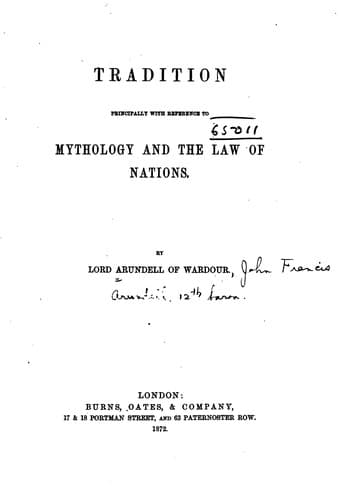
Tradition, Principally with Reference to Mythology and the Law of NationsArundell of Wardour, John Francis Arundell, Baron
Philosophy
Tradition, Principally with Reference to Mythology and the Law of Nations
Arundell of Wardour, John Francis Arundell, Baron
International law; Macdonell, George, 1780-1870; Mythology; Natural law; Tradition (Theology)
[79] Take for instance Mr J. S. Mill's peculiar views as to the
status of women, "The law of servitude in marriage" ["Wives
be obedient to your husbands," St Paul], he says, "is in
monstrous contradiction to all the principles of the modern
world" (p. 147). "Marriage is the only actual bondage known
to our law," _id._ But at p. 49, Mr Mill says, "The general
opinion of men is supposed to be, that the natural vocation
of a woman is that of a wife and mother." But he then adds
(p. 37), "It will not do to assert in general terms that the
experience of mankind has pronounced in favour of the existing
system. Experience cannot possibly have decided between two
courses, so long as there has only been _experience of one_.
If it be said that the doctrine of the equality of the sexes
rests only on theory, it must be remembered that the contrary
doctrine also has only theory to rest upon. All that is
proved in its favour by direct experience, is that mankind
have been able to exist under it, and to attain the degree of
improvement and prosperity which we now see; but whether that
prosperity has been attained sooner, or is now greater than it
would have been under the other system, experience does not
say."
Take in illustration, again, the communistic schemes
as against the institution of property. Now, although
Christianity has realised all that will ever be possible in
the way of communism in its religious orders, the communistic
sects have always instinctively directed their first efforts
against religion as against the basis of the social order of
things which they attacked. This was forcibly brought out in
certain letters on "European Radicalism," in the _Pall Mall
Gazette_, October and November 1869, _e.g._ "all the contests
on the three capital questions ('government, property,
religion') which we are now engaged in, are but continuations
of the _original divergence_ of opinion (before settled
government), considerably modified, of course, under the
influence of time, the various _traditional notions_ mankind
preserves under the _name of beliefs_, and the whole stock of
experience it has accumulated under the name of knowledge. So
like, indeed, are the ancient and modern contests on these
matters," &c.... (Letter I.) Again (Letter V.), speaking of
our English socialist discussing "the necessity of building
social edifices upon material, not religious grounds," the
writer adds, that among continental socialists "no one thinks
there of the possibility of matters standing otherwise;" and
that in the socialist workshops of France and Germany it is
well known "that the very basis of social radicalism requires
Public-domain text, read in full here on John Shaqi.
Reviews
Reviews
No reviews yet
Be the first to share your thoughts on this work.
Elsewhere in the archive
Join the Discussion
Join the discussion
Sign in to leave a comment or review.
Sign InorCreate an account