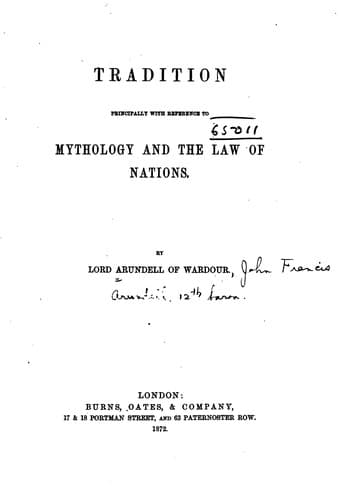
Tradition, Principally with Reference to Mythology and the Law of NationsArundell of Wardour, John Francis Arundell, Baron
Philosophy
Tradition, Principally with Reference to Mythology and the Law of Nations
Arundell of Wardour, John Francis Arundell, Baron
International law; Macdonell, George, 1780-1870; Mythology; Natural law; Tradition (Theology)
[95] _Vide_ H. N. Coleridge ("Greek Classic Poets," p. 38-42), in
speaking of the "Dionysiacs, the Thebaids, the Epigoniads,
Naupactica, genealogies, and the other works of that sort,"
p. 44, he adds--"Just as in the Indian and Persian epics, in
the Northern Eddas, in the poem of the 'Cid,' in the early
chronicles of every nation with which we are acquainted, one
story follows another story in the order of mere history; and
the skill and fire of the poet are shown, not in the artifice
of grouping a hundred figures into one picture, but in raising
admiration by the separate beauty of each successive picture.
_They tell the tale as the tale had been told to them, and
leave out nothing._"
[96] According to the account which the Chinese themselves give of
their annals, the works of Confucius were proscribed, after
his death, by the Emperor Chi-Hoangti, and all the copies,
including the Chu-King, were recovered from the dictation of
an old man who had retained them in memory.
"The great moralist of the East" himself, Confucius,
asserted--"that he only wrought on materials already
existing." _Vide_ Klaproth ap., Cardinal Wiseman, "Science and
Rev. Religion," ii. p. 49.
In the article in the _Cornhill Magazine_, Nov. 1871,
containing the valuable collection of Dravidian (South Indian)
folk-songs, it is said, p. 577, that "they are handed down
from generation to generation, entirely vivâ voce, and from
the minstrels have passed into public use."
And this seems to me the sufficient reply to Sir Charles Lyell's
somewhat captious objection, that if the intellectual knowledge of the
primitive age was so great, we ought now to be digging up steam engines
instead of flint implements.
Every age has its own peculiar superiority, as hath each individual
mind--_non omnia possumus omnes_--and it is as reasonable to object
to an age of philosophic thought, or of intuitive perception, that it
was not rich in the wealth of material civilisation, as it would be
to object to Plato or Shakspeare, that they did not acquire dominion
over mankind; or to Alexander, that he did not excel Aristotle; or
to Sir C. Lyell, supposing geology to be certain, that he did not
anticipate Darwin, supposing Darwinism to be true. And if it should
be more precisely objected that, if in those ages there was the
knowledge of writing for monumental purposes, we ought at least to find
monuments,[97] I say that the _onus probandi_ lies with the objector to
prove the invention or introduction of writing in the interval between
the age of Homer and the age of Pericles, as against us who believe in
its primeval transmission; or to show that its introduction was more
probable at this latter period than at the former.[98]
Public-domain text, read in full here on John Shaqi.
Reviews
Reviews
No reviews yet
Be the first to share your thoughts on this work.
Elsewhere in the archive
Join the Discussion
Join the discussion
Sign in to leave a comment or review.
Sign InorCreate an account