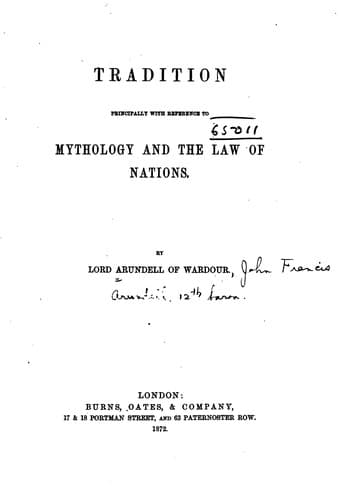
Tradition, Principally with Reference to Mythology and the Law of NationsArundell of Wardour, John Francis Arundell, Baron
Philosophy
Tradition, Principally with Reference to Mythology and the Law of Nations
Arundell of Wardour, John Francis Arundell, Baron
International law; Macdonell, George, 1780-1870; Mythology; Natural law; Tradition (Theology)
[97] The Duke of Argyll ("Primeval Man," p. 30) says--"Knowledge,
for example, or ignorance of the use of metals are, as we
shall see, characteristics on which great stress is laid"
(by the advocates of the "savage theory"). "Now, as regards
this point, as Whately truly says, the narrative of Genesis
distinctly states that this kind of knowledge did not belong
to mankind at first.... It is assumed in the savage theory
that the presence or absence of this knowledge stands in close
and natural connection with the presence or absence of other
and higher kinds of knowledge, of which an acquaintance with
metals is but a symbol and a type. Within certain limits this
is true."
[98] Presuming total ignorance of writing--its invention at _any_
period seems to me much more marvellous than the discovery
of printing after the invention of writing. For the rest we
have seen that writing was known at an early period to the
Chaldæans and Egyptians, and probably to the Chinese and
Japanese, and to the Medians (ch. xii.) Plutarch tells us
that a law of Theseus, written on a column of stone, remained
even to the time of Demosthenes.
Schlegel says[99]--
"I have laid it down as an invariable maxim to follow historical
tradition, and to hold fast by that clue, even when many things
in the testimony and declarations of tradition appear strange and
almost inexplicable; or, at least, enigmatical; for so soon as,
in the investigations of ancient history, we let slip that thread
of Ariadne, we can find no outlet from the labyrinth of fanciful
theories and the chaos of clashing opinion."
[99] Phil. Hist.
I propose to give a few instances of tradition, casually selected,
which appear to me to be in illustration of this dictum of Schlegel's.
Take, in illustration, the question whether mankind commenced with the
state of monogamy. Not that there is any obscurity on this point in
the Book of Genesis. It is indeed sometimes loosely said that we find
instances of polygamy in patriarchal times; but, as our Lord said, it
was not so in the beginning; and the Book of Genesis exhibits mankind
as commencing with a single pair, and subsequently as re-propagated
through a group of families, all represented to us at their
commencement as monogamous. But if this highest testimony is discarded,
and men gravely discuss whether or not they commenced with a state of
promiscuity, the argument from tradition will go for as much as the
argument from the analogy of circumstances and conditions as inferred
from the existing state of savages, since this state, from our point of
view, must have been the result of degeneracy.[100]
Public-domain text, read in full here on John Shaqi.
Reviews
Reviews
No reviews yet
Be the first to share your thoughts on this work.
Elsewhere in the archive
Join the Discussion
Join the discussion
Sign in to leave a comment or review.
Sign InorCreate an account