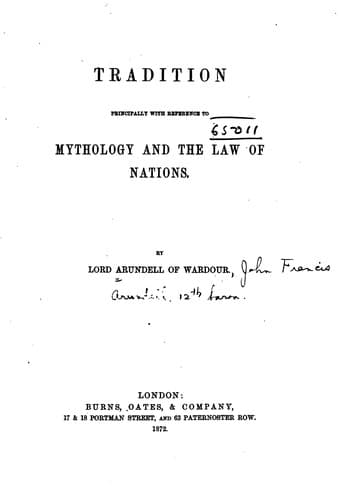
Tradition, Principally with Reference to Mythology and the Law of NationsArundell of Wardour, John Francis Arundell, Baron
Philosophy
Tradition, Principally with Reference to Mythology and the Law of Nations
Arundell of Wardour, John Francis Arundell, Baron
International law; Macdonell, George, 1780-1870; Mythology; Natural law; Tradition (Theology)
"Few traditions respecting the primitive condition of mankind are
more remarkable, and perhaps none are more ancient, than those that
have been preserved by Sanchoniatho; or rather, we should say,
that are to be found in the fragments ascribed to that writer by
Eusebius. They present us with an outline of the earlier stages
of human progress in religious speculation, which is shown _by
the results of modern inquiry to be wonderfully correct_. They
tell us for instance that '_the first men consecrated the plants
shooting out of the earth, and judged them gods_, and worshipped
them upon whom they themselves lived, and all their posterity,
and all before them, and to these they made their meat and drink
offerings.'[102] They further tell us that the first men believed
the heavenly bodies to be animals, only differently shaped and
circumstanced from any on the earth. 'There were certain animals
which had no sense, out of which were begotten intelligent animals
... and they were formed alike in the shape of an egg. Thus shone
out Môt [the luminous vault of heaven?], the sun and the moon,
and the less and the greater stars.' _Next they relate, in an
account of the successive generations of men_, that _in the first
generation the way was found out of taking food from trees_;
that, in the second, men, having suffered from droughts, began to
worship the sun--the Lord of heaven; that in the third, Light,
Fire, and Flame [conceived as persons], were begotten; that in the
fourth giants appeared; while in the fifth, 'men were named from
their mothers' because of the uncertainty of male parentage, this
generation being distinguished also by the introduction of 'pillar'
worship. It was not till the twelfth generation that the gods
appeared that figure most in the old mythologies, such as Kronos,
Dagon, Zeus, Belus, Apollo, and Typhon; and then the queen of
them all was the _Bull_-headed Astarte. The sum of the statements
is, that men first worshipped plants; next the heavenly bodies,
supposed to be animals; then 'pillars;' ... and, last of all, the
anthropomorphic gods. Not the least remarkable statement is, that
in primitive times there was kinship through mothers only, owing to
the uncertainty of fatherhood."[103]
[102] A tradition of the constellations, a proof from tradition that
they were so named in the ante-diluvian period.
[103] Sanchoniatho's "Phoenician History," by the Right Rev. R.
Cumberland. London, 1720, pp. 2, 3, 23, _et seq._ Eusebius,
Præpar. Evangel. lib. i. cap. 10.
The fragments of Sanchoniathon here referred to are found at earlier
date than Eusebius, having been copiously extracted by Philo (_vide_
Bunsen's "Egypt").
Public-domain text, read in full here on John Shaqi.
Reviews
Reviews
No reviews yet
Be the first to share your thoughts on this work.
Elsewhere in the archive
Join the Discussion
Join the discussion
Sign in to leave a comment or review.
Sign InorCreate an account