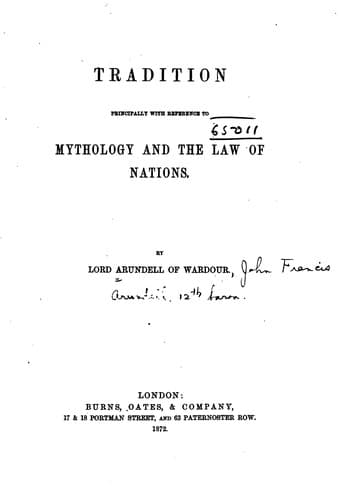
Tradition, Principally with Reference to Mythology and the Law of NationsArundell of Wardour, John Francis Arundell, Baron
Philosophy
Tradition, Principally with Reference to Mythology and the Law of Nations
Arundell of Wardour, John Francis Arundell, Baron
International law; Macdonell, George, 1780-1870; Mythology; Natural law; Tradition (Theology)
Sanchoniathon was to Phoenicia what Berosus was to Assyria; that is
to say, the earliest post-diluvian compilers of history when tradition
was becoming obscure. Let us scrutinise his testimony. We are here
told "that the first men _consecrated the plants_ shooting out of the
earth, and _judged them gods_."... "Next they relate, in an account of
the successive generations of men, that in the first generation _the
way was found out of taking food from trees_." Here, I submit, that we
have plainly and unmistakably a tradition of that first commencement
of evil, the first man and woman plucking the apple from the tree,
thinking they would become as gods (Gen. iii. 4, 5), ... "and the
serpent said ... for God doth know that in what day soever you shall
eat thereof ... and you shall be as gods, knowing good and evil."
Then follows the succession of ages (_vide infra_, ch. xiii.), of
which there is a curious parallel tradition in Hesiod and Apollodorus,
and partial correspondences in the traditions of India, China, and
Mexico (_infra_, ch. xiii.).[104]
[104] _Vide_ Grote, i.
It will be noted, however, that whilst running into the tradition of
Hesiod on the one side (in Hesiod and in the Chinese tradition there
is trace of a double tradition, ante and post-diluvian), Sanchoniathon
still more closely runs in with the narrative of Genesis on the other,
thus connecting the links of the chain of tradition.[105]
[105] This chapter was written before I became acquainted with Mr
Palmer's "Chronicles of Egypt" (_vide_ ch. vi.) If the
reader will refer to chap. i., he will there find a learned
and exhaustive exposition of the ages of Sanchoniathon,
identifying them with Scripture on the one side, and Egyptian
tradition on the other.
Public-domain text, read in full here on John Shaqi.
Reviews
Reviews
No reviews yet
Be the first to share your thoughts on this work.
Elsewhere in the archive
Join the Discussion
Join the discussion
Sign in to leave a comment or review.
Sign InorCreate an account