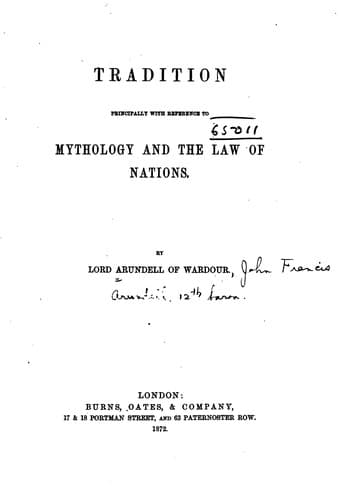
Tradition, Principally with Reference to Mythology and the Law of NationsArundell of Wardour, John Francis Arundell, Baron
Philosophy
Tradition, Principally with Reference to Mythology and the Law of Nations
Arundell of Wardour, John Francis Arundell, Baron
International law; Macdonell, George, 1780-1870; Mythology; Natural law; Tradition (Theology)
In the succession of ages we have in outline the history of mankind in
the ante-diluvian period--the Fall, _supra_--followed in the succeeding
age by a great _drought_--[compare this tradition with the following
passage in Fran. Lenormant's "Histoire Ancienne," i. p. 5, 2d ed.,
Paris 1868--"and when geology shows us the first ante-diluvian men who
came into our part of the world, living in the midst of ice, under
conditions of climate analogous to those under which the Esquimaux live
at the present day ... one is naturally brought to the recollection
of _that ancient tradition of the Persians_, fully conformable to the
information which the Bible supplies on the subject of the fall of man,
... which ranks among the first of the chastisements which followed
the fall, along with death and other calamities, the advent of an
_intense and permanent cold_ which man could scarcely endure, and which
rendered the earth almost uninhabitable."[106]] It is to this period,
and the short period immediately following the Deluge (_vide_ ch. ii.
p. 21, and _infra_, pp. 136, 137), that I am inclined to trace
the notions of a primitive barbarism--compare, for instance, the facts
which Goguet, in his "Origin of Laws," i. p. 72, adduces in proof of
his progress from barbarism, with the above tradition of the Persians
recorded by Lenormant.
[106] Is not this the meaning of the cxlvii. psalm, in the
expression, "ante faciem frigoris ejus quis sustinebit"?
Does not the psalm recount to the Jewish people, in rapid
allusions, all that God had done for them, in contrast to the
chastisements that had befallen other nations; and if it is
objected that there is no allusion to the Deluge, unless in
its indirect and beneficial influences, in the words, "flavit
spiritus ejus et fluent aquæ," I reply that to the survivors,
the Deluge, regarded largely, and in its permanent effects,
was no calamity, but the commencement of a new and more
favoured era.
Goguet says--"The Egyptians, Persians, Phoenicians, Greeks, and
several other nations (_vide_ his references, p. 72), acknowledged that
their ancestors were once without the use of fire. The Chinese confess
the same of their progenitors.... Pomponius, Mela, Pliny, Plutarch, and
other ancient authors speak of nations, who, at the time they wrote,
knew not the use of fire, or had only just learned it. Facts of the
same kind are attested by several modern relations." Let this latter
statement be compared with _infra_, pp. 136, 137 .
Public-domain text, read in full here on John Shaqi.
Reviews
Reviews
No reviews yet
Be the first to share your thoughts on this work.
Elsewhere in the archive
Join the Discussion
Join the discussion
Sign in to leave a comment or review.
Sign InorCreate an account