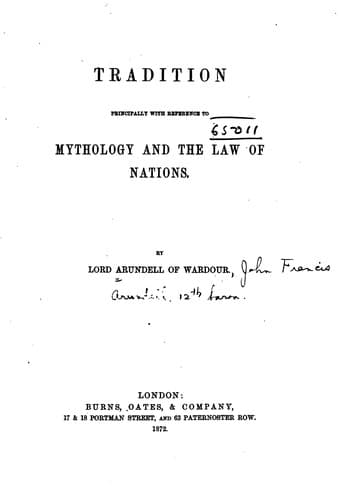
Tradition, Principally with Reference to Mythology and the Law of NationsArundell of Wardour, John Francis Arundell, Baron
Philosophy
Tradition, Principally with Reference to Mythology and the Law of Nations
Arundell of Wardour, John Francis Arundell, Baron
International law; Macdonell, George, 1780-1870; Mythology; Natural law; Tradition (Theology)
Colonel Macdonell was subsequently partially reinstated in his command
of the Glengarry regiment. The important services rendered by Colonel
Macdonell in Canada, to which I have alluded, were--1. The taking
of Ogdensburg at a critical moment, on his own responsibility, and
contrary to orders, which had the effect of diverting the American
attack from Upper Canada at a moment when it was entirely undefended;
and, 2. Bringing the regiment of French Canadian militia, then
temporarily under his command, from Kingston, by a forced run down
the rapids of the St Lawrence without pilots (passing the point where
Lord Amherst lost eighty men), in time enough (he arrived the day
before, unknown to the Americans) to support De Saluberry at the
decisive action at Chateaugay. De Saluberry indeed had only 300 French
Canadians under his command, which, with the 600 brought up by Colonel
Macdonell, only made up a force of 900 (with about 100 Indians), with
which to check General Hampton's advance with some 7000 (the Americans
stated the force at 5520 infantry and 180 cavalry, James, i. 305) in
his advance on Montreal. In point of fact, Colonel Macdonell must be
considered, on any impartial review of the facts, to have won the day
(_vide infra_), yet he was not even mentioned in Sir G. Prevost's
dispatch.
Colonel Macdonell received the Companionship of the Bath for the taking
of Ogdensburg, and the gold medal for his conduct in the action at
Chateaugay.
I append the following accounts of the affairs at Ogdensburg
and Chateaugay, adding a few particulars in correction and
explanation--Alison, "History of Europe," xix. 121 (7th ed.),
says--"Shortly after Colonel M'Donnell (Macdonell), with two companies
of the Glengarry Fencibles, and two of the 8th, converted a _feigned_
attack which he was ordered to make on Fort Ogdensburg into a real one.
The assault was made under circumstances of the utmost difficulty;
deep snow impeded the assailants at every step, and the American
marksmen, from behind their defences, kept up a very heavy fire; but
the gallantry of the British overcame every obstacle, and the fort was
carried, with _eleven guns, all its stores_, and _two armed schooners_
in the harbour." The difficulties, as I have understood from Colonel
Macdonell, were not so much from the impediments of the snow, as from
the dangerous state of the St Lawrence at the time, the ice literally
waving under the tramp of his men as he passed them over (ten paces
apart). The stroke of the axe, by which they judged, told it indeed to
be only barely safe, and it had never been crossed by troops before at
that point, as it was deemed insecure, being within three miles of the
Gallops Rapids. (Among the guns were some taken from General Burgoyne.)
Public-domain text, read in full here on John Shaqi.
Reviews
Reviews
No reviews yet
Be the first to share your thoughts on this work.
Join the Discussion
Join the discussion
Sign in to leave a comment or review.
Sign InorCreate an account