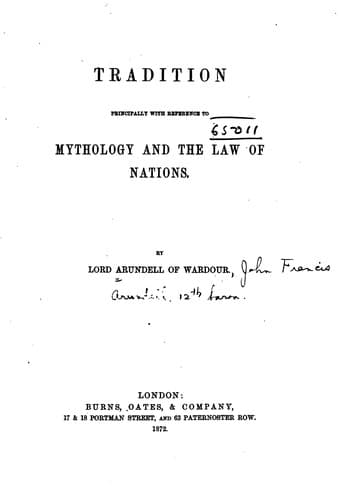
Tradition, Principally with Reference to Mythology and the Law of Nations — John Shaqi
Tradition, Principally with Reference to Mythology and the Law of NationsArundell of Wardour, John Francis Arundell, Baron
Philosophy
Tradition, Principally with Reference to Mythology and the Law of Nations
Arundell of Wardour, John Francis Arundell, Baron
International law; Macdonell, George, 1780-1870; Mythology; Natural law; Tradition (Theology)
Under these circumstances it will be recognised as of some importance
that Colonel Macdonell was able to raise a regiment among the
Macdonells of his clan who had settled there. But the conditions made
with him were not fulfilled, and the command of the regiment, almost
immediately after it was raised, was transferred to the command of
a Protestant and an Orangeman, which caused a mutiny which was with
difficulty suppressed. Now, it must be borne in mind that the regiment
was only raised through his personal influence with the clan, and
through that of its pastor, Bishop Macdonell, and that the adhesion
of the Catholic Macdonells went far to determine the attitude of the
French Canadians also. There were not more than 1200 regular troops in
Upper Canada during the war.[4]
[4] W. James, "Military Occurrences of Late War," i. 56, says,
1450 regular troops; Murray, "History of British America," i.
189, says, 2100 troops.
Before referring to the actions in which Colonel Macdonell was engaged,
I will add the following particulars as to the Highland settlement
which Colonel Macdonell gave me. In 1798, the submission of the
Highland chiefs to the House of Hanover having been of some standing,
and their adhesion being, moreover, cemented in a common sentiment of
abhorrence of the French Revolution, they were willingly induced to
raise regiments among their clans. This was done by Glengarry, Macleod,
and others. At the peace these regiments were disbanded, but finding
that complications of various sorts had necessarily arisen during their
absence respecting their lands and holdings at home, and, in point of
fact, that they had no homes to return to, the greater part remained
temporarily domiciled at Glasgow, the place of their disbandment. I
infer that they remained under the charge and direction of Bishop
Macdonell, who had accompanied them in their campaigns as chaplain, and
was the first Catholic priest officially recognised in the capacity of
regimental chaplain. At Glasgow (previously only served as a flying
mission), he hired a storehouse, which he opened as a chapel, but
stealthily only, as two of the congregation were always posted as a
guard at the entrance on Sunday. He found only eighteen Catholics at
Glasgow at that time, i.e., I suppose, previously to the disbandment
of the Highlanders. Through Bishop Macdonell's influence with Lord
Sidmouth--who, although a strong opponent of the Catholic claims,
always acted in his relations with him, he said, in the most honourable
and straightforward way--the emigration of the Highlanders to Canada
was shortly afterwards arranged.
Public-domain text, read in full here on John Shaqi.
Reviews
Reviews
No reviews yet
Be the first to share your thoughts on this work.
Join the Discussion
Join the discussion
Sign in to leave a comment or review.
Sign InorCreate an account