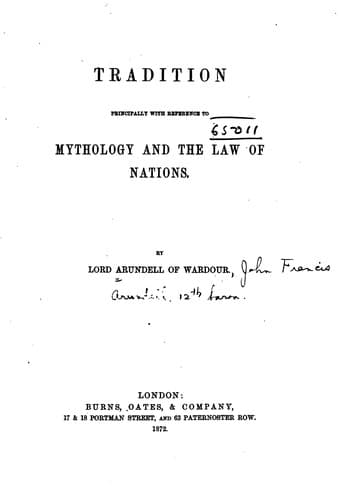
Tradition, Principally with Reference to Mythology and the Law of NationsArundell of Wardour, John Francis Arundell, Baron
Philosophy
Tradition, Principally with Reference to Mythology and the Law of Nations
Arundell of Wardour, John Francis Arundell, Baron
International law; Macdonell, George, 1780-1870; Mythology; Natural law; Tradition (Theology)
In the third age we are told--"Light, Fire, and Flame (conceived as
persons) were begotten," which looks like a tradition of Vulcan,
Tubalcain, &c. (_vide_ ch. xii. _infra_); and "in the fourth, giants
appeared;" while in the fifth, the corruption of mankind is indicated,
as is declared in Genesis vi. 4: "Now giants were upon the earth in
those days. For after the sons of God went in to the daughters of men
and brought forth children," &c., ver. 12, "and when God had seen
that the earth was corrupted (for all flesh had corrupted its way
upon the earth), ver. 13, He said to Noe," &c. "It was not till the
twelfth generation that the gods appeared that figured most in the
old mythologies," says Mr M'Lennan, quoting Sanchoniathon, or what is
believed to be his testimony. I trust that this fragment of tradition
may be remembered in connection with what I have written in chapters
viii., ix., x. [107]
[107] Compare ch. xiii. The successive ages of Hesiod, more
especially the lines describing the iron age, parallel to the
tradition, _supra_, "that in the fifth age _men were named
from their mothers_."
"No fathers in their sons their features trace,
The sons reflect _no more_ their father's face;
The host with kindness greets his guest no more,
And friends and brethren love not as of yore."
--HESIOD.
President Goguet ("Origin of Laws," i. 21,) had noticed
the ancient allusions to "kinship through mothers," and
his statement that "women belonged to the man who seized
them first.... The children who sprang from this irregular
intercourse scarce ever knew who were their fathers. They knew
only their mothers, for which reason they always bore their
name." For this statement he also quotes Sanchoniathon, ap.
Eus. p. 34, as his principal authority. But Sanchoniathon's
statement, as we have seen, refers to the ante-diluvian
period, in which it is borne out by Genesis vi. 4.
There is one fact adduced by Goguet (i. 43), viz. that the
_Assyrians_ had an analogous ceremony which must be decisive
for us, though not, perhaps, for Mr M'Lennan, that the custom
of seizure was ante-diluvian, since the commencement of the
Assyrian monarchy in the times immediately following the
flood, is one of the best established foundations of history.
_Vide_ Genesis and Rawlinson.
"This race of _many languaged_ man." To any one who rightly
grasps the bearing of the argument, the appositeness of
this quotation will, I think, be rather strengthened than
diminished by the evidence that the lines of Hesiod plainly
refer to post-diluvian times (_vide_ ch. xiii.)
Public-domain text, read in full here on John Shaqi.
Reviews
Reviews
No reviews yet
Be the first to share your thoughts on this work.
Elsewhere in the archive
Join the Discussion
Join the discussion
Sign in to leave a comment or review.
Sign InorCreate an account