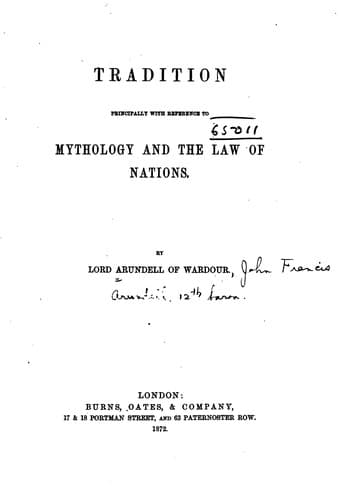
Tradition, Principally with Reference to Mythology and the Law of NationsArundell of Wardour, John Francis Arundell, Baron
Philosophy
Tradition, Principally with Reference to Mythology and the Law of Nations
Arundell of Wardour, John Francis Arundell, Baron
International law; Macdonell, George, 1780-1870; Mythology; Natural law; Tradition (Theology)
"The sum of the statements" then, so regarded, is to confirm the
tradition of the human race as recorded in Genesis, that they sprang
from three brothers and their three wives, forming three monogamous
pairs who accompanied their father Noah into the ark, with his wife;
and who again were more remotely descended from a single pair.
If, then, in the two most ancient traditions of which we have any
record, we find concordance on some points and divergence on others,
the circumstance of identity at all is so much more startling than the
occurrence of discrepancy, that it will fairly be taken to warrant
the presumption of a common origin; and this conformity will also be
naturally claimed in support of our narrative as against the other
on the points of disagreement, which will then be set down to the
corruption of that which is deemed the most ancient and authentic.
For those, therefore, who believe the Bible to be the revealed Word
of God, and even for those who regard it as the most ancient record,
the coincidences with Sanchoniathon will afford a striking testimony;
whereas the coincidence of the fifth age of Sanchoniathon with
Genesis (chap. vi. 1, 2, 4) and the tradition of Hesiod, must be an
embarrassment to those who seek in this tradition evidence that what
was characteristic of the fifth age, was true of the preceding and
pristine ages.
To take a second instance, more exactly in illustration of the
quotation from F. Schlegel, _supra_, p. 124, there is no such barrier
to tradition (regarded retrospectively) as the notion, if we accept
it, which crept over many nations, that they were "autochthones."
Like the sand-drifts known to geologists as dunes, such notions, if
they had been received absolutely, would have involved all tradition
in a general extinction. But as the dunes, when minutely measured and
submitted to calculation, have afforded the best evidence in favour
of what may be called the diluvian chronology, so will this notion
that men sprang out of the soil in which they dwelt, when analysed,
contribute fresh evidence to the truth and persistence of tradition.
But first of all, will any one start with the theory--that any nation
that had this notion about itself--the Greeks, for instance, were
really autochthones? There is, then, simply a confusion of ideas, a
difficulty which has to be unravelled; but seeing that the Greeks
notoriously believed themselves to be autochthones, it becomes an
obstruction in the main channel of tradition, and it is especially
incumbent upon us to consider the facts.
In the "Supplicants" of Æschylus--and I am not aware that the notion
crops up at earlier date--Pelasgus is introduced as saying--
"Pelasgus bids you, sovereign of the land,
My sire, Palæcthon, of _high ancestry,
Original_ with this _earth_; from me, their king,
The people take their name, and boast themselves
Pelasgians."
--v. 275.
Public-domain text, read in full here on John Shaqi.
Reviews
Reviews
No reviews yet
Be the first to share your thoughts on this work.
Elsewhere in the archive
Join the Discussion
Join the discussion
Sign in to leave a comment or review.
Sign InorCreate an account