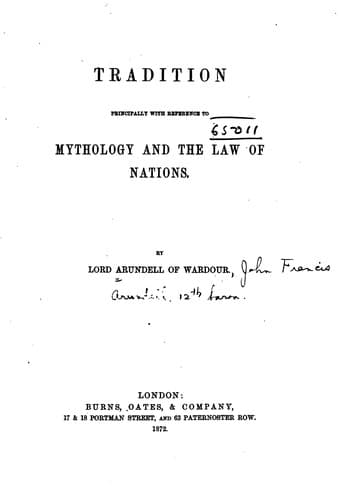
Tradition, Principally with Reference to Mythology and the Law of NationsArundell of Wardour, John Francis Arundell, Baron
Philosophy
Tradition, Principally with Reference to Mythology and the Law of Nations
Arundell of Wardour, John Francis Arundell, Baron
International law; Macdonell, George, 1780-1870; Mythology; Natural law; Tradition (Theology)
Here the high descent, and the origin from the soil, the ancestry
referred to in the same breath with the allusion to his sire, "original
with this earth," strikes one as incongruous. And the incongruity
appears still greater when we recollect that Pelasgus is the person
whom all historical evidence proves to have been the first settler in
the country; it being also borne in mind that the term "autochthones,"
whether in a primary or a secondary sense, is always applied to the
supposed aboriginals of the country, and therefore excludes the
hypothesis of any more primitive colonisation.[108]
[108] The Phoenician cosmogony seems to me to clinch the argument.
There (_vide_ Bunsen, Egypt, iv. 234), "_The son of Eliun_ is
called by Philo, Epigeios or _autokhthon_, 'the earth-born,'
primeval inhabitant. By the latter of these expressions we
have no doubt that Adam-Tadmon ('the Kadmos of the Greeks,'
p. 195), the first man, the man of God, is implied" ("Eliun,
_i.e._ Helyun, God the Most High," p. 232).
There is an analogy in their confused tradition of the
creation. "Eudemus says, according to the Phoenician
mythology, which _was invented by Môkhos_, the first principle
was æther and air; from these two beginnings sprang Ulômos
(the eternal), the rational (conscious) God" (Bunsen, iv.
179). Bunsen, (178) adds, "as regards Môkhos the thing is
clear enough; the old materialistic philosopher is matter,
and that in the sense of primeval slime." [Whence it has been
suggested that we derive our word Muck, Môkh, or Môkhos.]
This beginning Bunsen considers (p. 179) "a philosophising
amplification of the simply sublime words of Genesis: 'The
earth was without form, and void, and darkness was over the
face of the waters.'" Here we see the human reason hampered
by the tradition that confused matter or chaos was somehow
at the commencement, and with the conflicting tradition and
conclusion of the intellect that it was, and must have been,
created by a power superior to matter ("In the beginning God
created heaven and earth"), emancipating itself, so far as to
identify the Creator with the æther and air, as nearer the
conception of a pure Spirit, and personifying matter, and so
shunting it aside as the "inventor of the mythology."
Public-domain text, read in full here on John Shaqi.
Reviews
Reviews
No reviews yet
Be the first to share your thoughts on this work.
Elsewhere in the archive
Join the Discussion
Join the discussion
Sign in to leave a comment or review.
Sign InorCreate an account