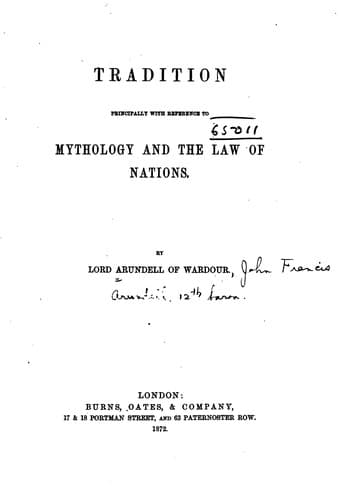
Tradition, Principally with Reference to Mythology and the Law of NationsArundell of Wardour, John Francis Arundell, Baron
Philosophy
Tradition, Principally with Reference to Mythology and the Law of Nations
Arundell of Wardour, John Francis Arundell, Baron
International law; Macdonell, George, 1780-1870; Mythology; Natural law; Tradition (Theology)
But if we regard it as a corruption of the tradition that man was
created out of the earth ("for dust thou art, and unto dust thou shalt
return," Genesis iii. 19), does not this solve all difficulties? The
extension of the knowledge that they were created out of the earth, to
the notion that they were created out of this or that particular clay,
is not violent. Is it not this same Æschylus[109] who has the allusion
"to the earth drinking the blood of the two rival brothers, the one
slain by the other." It will be seen at p. 175, that the Mexicans
believed that the first race of men were created "out of the earth,"
and "the third out of a tree," a reminiscence of the creation, and of
the fall, the intermediate event being probably the creation of Eve. In
like manner, the Red Indians have a tradition that they were created
out of the _red clay_ by the Great Spirit; and to go to another part of
the world, the supposed aboriginal tribes of China were called Miautze,
or "soil children."[110]
[109] _Vide_ De Maistre (ch. xii.)
[110] Max Müller, "Chips," &c., ii. 274. The Titans were also said
to be "earth-born." Bryant (iii. 445) says Berosus gives the
following tradition of the Creation. Belus after deification
being confounded with the Creator, as we have seen Prometheus,
id. 104--"Belus, the deity above mentioned, cut off his own
head, upon which the other gods mixed the blood as it gushed
out _with the earth_, and _from thence_ men _were formed. On
this_ account it is that they are rational and partake of
divine knowledge. _This_ Belus, whom men called _Dis, divided
the darkness_ and separated the heavens from the earth," &c.
This testimony must be connected with the phrase so startling in the
seventh ode of the fourth book of Horace, "_pulvis_ et umbra sumus,"
and with the text in Genesis iii. 19, "for dust thou art."[111] It may
possibly be said that this is merely matter of every day's experience.
But it is precisely at this point that we must ask those who dispute
tradition to discard tradition. Do bodies--so far as the exterior
senses tell us--return to dust, or to other forms of life? If it is
true that we return to dust--Scripture apart--it is tradition and not
experience which attests it, and yet so common is the belief, that it
might readily pass as the result of common observation.
[111] Compare Cicero, De Legibus, i. 8: "Est igitur homini _cum deo
similitudo_;" and with Gen. ii. 26, 27: "and God created man
in his own likeness."
Public-domain text, read in full here on John Shaqi.
Reviews
Reviews
No reviews yet
Be the first to share your thoughts on this work.
Elsewhere in the archive
Join the Discussion
Join the discussion
Sign in to leave a comment or review.
Sign InorCreate an account