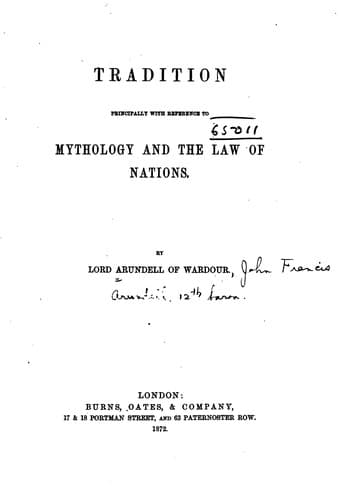
Tradition, Principally with Reference to Mythology and the Law of NationsArundell of Wardour, John Francis Arundell, Baron
Philosophy
Tradition, Principally with Reference to Mythology and the Law of Nations
Arundell of Wardour, John Francis Arundell, Baron
International law; Macdonell, George, 1780-1870; Mythology; Natural law; Tradition (Theology)
So general a tradition that man was created, and created out of
the ground,[112] is so completely in accordance with the text of
Genesis, that one can hardly see what more can be demanded; yet
Catlin says[113]--"Though there is not a tribe in America but what
has _some_ theory of man's _creation_, there is not one amongst them
all that bears the _slightest resemblance_ to the Mosaic account."
Catlin instances the traditions of the Mandans, Choctaws, and the
Sioux--_1st_, The Mandans (who have the ceremony commemorative of
_the Deluge_ referred to, ch. xi.), believe that they were created
"under the ground." _2d_, The Choctaws assert that they "were created
crawfish, living alternately under the ground and above it as they
chose; and, creeping out at their little holes in the earth to get the
warmth of the sun one sunny day, a portion of the tribe was driven
away and could not return; they built the Choctaw village, and the
remainder of the tribe are still living under the ground." The Iroquois,
however, believe that they "came out of the ground," which is identical
with the Greek notion of their being "autochthones" (_vide_ Colden,
ii. 103), where one of their chiefs speaks thus--"For we must tell you
that long before one hundred years our ancestors _came out of this very
ground_.... You _came out of the ground_ in a country that lies beyond
the seas." Now, even if we consent to detach the Iroquois tradition,
there is still in both the Mandan and Choctaw tradition, a common idea
of their having come from "under the ground," which seems to me the
tradition that they were created out of the ground at one remove. To
this it would seem the Choctaws have super-added their recollection
of some incident of their tribe, possibly that they were an offshoot
of the Esquimaux, or were at one period in their latitude and lived
their life, which would be in accordance with the theory of their
migrations from Asia by Behring's Straits. 3_d_, About the Sioux, the
third instance of contrariety adduced by Catlin, it seems to me that
there is no room for argument, the Sioux having the tradition referred
to above, that the Great Spirit _told_ them that "The red stone was
their flesh." To these three instances Mr Catlin adds--"Other tribes
were created under the water, and at least _one half of the_ tribes in
America represent that man was created _under the ground_ or in the
rocky caverns of the mountains. Why this diversity of theories of the
Creation if these people brought their traditions of the Deluge from
the land of inspiration?"[114]
Public-domain text, read in full here on John Shaqi.
Reviews
Reviews
No reviews yet
Be the first to share your thoughts on this work.
Elsewhere in the archive
Join the Discussion
Join the discussion
Sign in to leave a comment or review.
Sign InorCreate an account