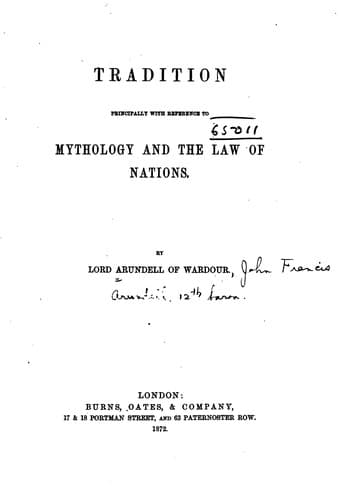
Tradition, Principally with Reference to Mythology and the Law of NationsArundell of Wardour, John Francis Arundell, Baron
Philosophy
Tradition, Principally with Reference to Mythology and the Law of Nations
Arundell of Wardour, John Francis Arundell, Baron
International law; Macdonell, George, 1780-1870; Mythology; Natural law; Tradition (Theology)
[112] "The Chinese cosmogony speaks as follows of the creation of
man--'God took some yellow earth, and He made man _en deux
sexes_.'" This is the true origin of the human race. A Hebrew
tradition says that it was of the red earth, which is the
same idea. The Hebrew word "Adam" expresses this idea. This
correspondence as to the manner in which the body of the
first man was formed, between two people who have never had
relations, is very remarkable. Indian and African cosmogonies
relate that the name of the first man was 'Adimo,' that of
his wife 'Hava,' and that they were the last work of the
Creator."--Gainet, _La Bible sans la Bible_, i. p. 74. I must
note, too, the identity of the American Indian (_supra_) and
the Hebrew tradition, which is curious, as it might naturally
be supposed that the tradition of the Red Indian took its
_colour_ from his own complexion.
Max Müller ("Lect. on the Science of Language," 1st series,
p. 367) says of "man"--"The Latin word _homo_, the French
_l'homme_, ... is _derived from the same root_, which we
have in _humus_, soil, _humilis_, humble. _Homo_, therefore,
would express the idea _of being made out of the dust
of the earth_." Bunsen also ("Phil. Univ. Hist." i. 78)
says--"The common word for man in all German dialects is
'manna,' containing the same root as Sanscrit 'manusha' and
'manueshya.' The Latin 'homo' is intimately connected with
'humus' and [Greek: chamai] and means _earth-born_; [Greek:
anthrôpôn chamaigeneôn], says Pindar. But what is [Greek:
anthrôpos]?"
[113] "Last Rambles," p. 324.
[114] The following tradition of the Tartar tribes seems to supply a
link. In their tradition of the Deluge (_vide_ Gainet, i. 209)
it is said, "that those who saved themselves from the Deluge
shut themselves up with their provisions in the crevices of
mountains, and that after the scourge had passed they came out
of their caverns."
And compare, again, with the tradition of Kronos (Noah, _vide_
Bryant's "Mythology," iii. 503)--"He is said to have had
_three_ sons (Sanch. ap. Euseb. P. E., lib. i. c. 10, 37), and
in a _time of danger_ he formed a _large cavern in the ocean_,
and in this he shut himself up, together _with these sons_,
and thus escaped the danger."--_Porph. de Nymphar. Antro._, p.
109.
Public-domain text, read in full here on John Shaqi.
Reviews
Reviews
No reviews yet
Be the first to share your thoughts on this work.
Elsewhere in the archive
Join the Discussion
Join the discussion
Sign in to leave a comment or review.
Sign InorCreate an account