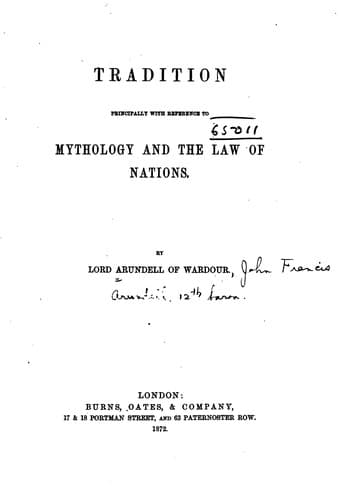
Tradition, Principally with Reference to Mythology and the Law of NationsArundell of Wardour, John Francis Arundell, Baron
Philosophy
Tradition, Principally with Reference to Mythology and the Law of Nations
Arundell of Wardour, John Francis Arundell, Baron
International law; Macdonell, George, 1780-1870; Mythology; Natural law; Tradition (Theology)
Bryant ("Mythology," iii. 405) says--"I have shown that Gaia,
in its original sense, signified a sacred cavern, a hollow in
the earth, which, from its gloom, was looked upon as an emblem
of the ark. Hence Gaia, like Hasta Rhoia Cybele, is often
represented as the mother of mankind." The following is very
important with reference to my argument above:--The Scholiast
upon Euripides says--"[Greek: Meta ton kataklysmon en oresin
oikountôn tôn Argeiôn prôtos autous synôkisen Inachos]. When
the Argivi or Arkites, _after the Deluge_, lived _dispersed on
the mountains_, Inachus first brought them together and formed
them into communities."--Comp. _infra_, p. 157, 158, 193,
332.
The instances adduced of myths connecting man with the monkey
are, as a rule, traditions of degeneracy, _i.e._ of men turned
into monkeys (_vide_ Tylor's "Primitive Culture," i. 340),
and to which I would add the rabbinical tradition of men
turned into monkeys at the Tower of Babel (De Quincey, Works,
xiii. 235), and the classical epic of the Ceropes, "founded
on the transformation of a set of jugglers into monkeys."
But if compared with the above tradition, I think that the
only two instances (Tylor, i. 341) which seem to bear out the
opposite theory will wear a different aspect. I quote from
Tylor as above--"Wild tribes of the Malay peninsula, looked
down upon as lower animals by the more warlike and civilised
Malays, have among them traditions of their own descent from
_a pair_ of the "unka-putch" or _white_ monkeys, who reared
their young ones _and sent them into the plains_, and there
they perfected so well that they and their descendants became
men, but those _who returned to the mountains_ still remained
apes. The Buddhist legend relates the origin of the flat-nosed
uncouth tribes of Tibet, offspring of _two miraculous apes_,
transformed to _people_ the snow-kingdom. Taught to till the
ground, when they had grown corn and eaten it, their tails
and hair gradually disappeared, they began to speak, became
men, and clothed themselves with leaves. The population grew
closer, the land was more and more cultivated, and at last a
prince of the race of Sakya, driven from his home in India,
_united their isolated tribes_ into a single kingdom."--Comp.
Cecrops, &c., p. 332, _infra_.
Now, just as the tribes who said they were created "under the ground"
implied the same tradition as those who said they were created _out
of_ the ground, so, too, the tribes who said they were created "under
the water" probably held the tradition that the creation of the race
preceded the Deluge.
Public-domain text, read in full here on John Shaqi.
Reviews
Reviews
No reviews yet
Be the first to share your thoughts on this work.
Elsewhere in the archive
Join the Discussion
Join the discussion
Sign in to leave a comment or review.
Sign InorCreate an account