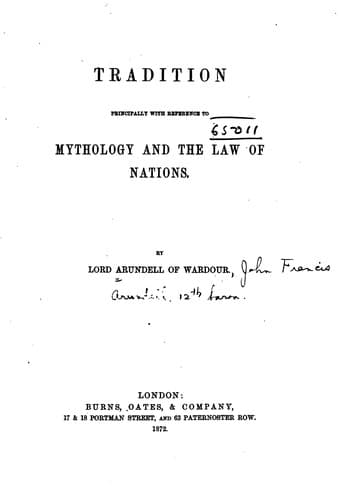
Tradition, Principally with Reference to Mythology and the Law of NationsArundell of Wardour, John Francis Arundell, Baron
Philosophy
Tradition, Principally with Reference to Mythology and the Law of Nations
Arundell of Wardour, John Francis Arundell, Baron
International law; Macdonell, George, 1780-1870; Mythology; Natural law; Tradition (Theology)
The tradition which connects the creation with "the rocky caverns of
the mountains" is more recondite--may it possibly be a recollection of
the commencement of civil life after the Deluge, when Noah led them,
according to tradition, from the mountains to the plains?
M. L'Abbé Gainet says (i. 176)--"The Lord repeated four times the
promise that He would not send another deluge.... The children of Noah
were long scared by the recollection of the dreadful calamity.... It is
probable that they did not decide upon leaving the 'plateaux' of the
mountains till quite late. Moreover, caverns have been found in the
mountains of the Himalaya, and in many other elevated regions of Asia,
which they suppose to have been formed by the first generations of man
after the Deluge. The works of the learned M. de Paravey make frequent
mention of them." This tradition is supported by the lines of Virgil
referring to Saturn (_vide infra_, p. 210).
"Is genus indocile, ac dispersum _montibus altis_
Composuit; legesque dedit."--_Æn._ viii. 315.
I give these suggestions for what they may be worth.[115] Truly,
where some see nothing but harmony, others see nothing but diversity.
Only to put it to a fair test, I should like to see Mr Catlin or
some one else group these various traditions round any one tradition
which they believe to be at variance with the revelation of Genesis,
and which, at the same time, they happen to consider to be the true
one. It must be conceded that in one way the facts accord with Mr
Catlin's theory--contradicted, however, by other evidence (_infra_, ch.
xi.)--that the Indians were created on the American continent. But
upon any theory that they were not created at all, but existed always
in pantheistic transformation, or had progressed from the monkey,
or had been developed in evolution from some protoplasm, is not the
tradition incongruous and inexplicable?
[115] It occurs to me as possible that these various traditions may
have had their foundation in the recollection of hardship, at
some early period of their subsequent migration, which were
transferred back and connected with their tradition of the
altered state of things after the Deluge, arising out of the
substitution of animal for vegetable food--of which the notion
that man once lived on acorns may have been only an extreme
form of expression. The following tradition of Saturn (_vide
infra_, Saturn, p. 210), seems to tend in this direction:
"Diodorus Siculus gives the same history of Saturn as is by
Plutarch above given of Janus--[Greek: ex agriou diaitês eis
êmeron Bion metarêsa anthrôpous].--Diodorus, 1. 5, p. 334. He
brought mankind from their foul and savage way of _feeding_ to
a more mild and rational _diet_."--Bryant, ii. 261.
Public-domain text, read in full here on John Shaqi.
Reviews
Reviews
No reviews yet
Be the first to share your thoughts on this work.
Elsewhere in the archive
Join the Discussion
Join the discussion
Sign in to leave a comment or review.
Sign InorCreate an account