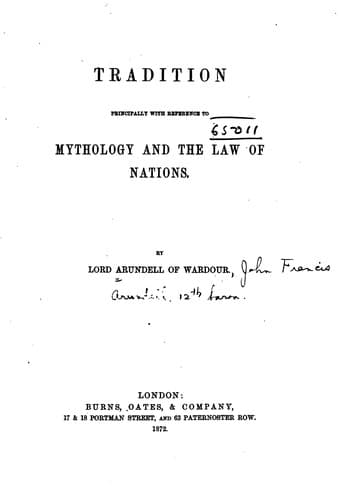
Tradition, Principally with Reference to Mythology and the Law of NationsArundell of Wardour, John Francis Arundell, Baron
Philosophy
Tradition, Principally with Reference to Mythology and the Law of Nations
Arundell of Wardour, John Francis Arundell, Baron
International law; Macdonell, George, 1780-1870; Mythology; Natural law; Tradition (Theology)
To take another instance. The Hindoos had a fanciful notion that the
world was supported by an elephant, and the elephant by a tortoise.
Nothing can be imagined more incongruous and grotesque. Yet Dr Falconer
has recently discovered, in his explorations in India, a fossil
tortoise adequate to the support of an elephant. The incongruity then
of the tradition disappears; its grotesqueness remains. I cannot help
thinking, however, that it may have been the embodiment in symbol, or
else the systematisation of the confused medley of their tradition
of the order, _i.e. of the sequence of days of the creation_ (_vide_
Appendix to this chapter).[116]
[116] This fable of the tortoise is also among the Mandans, whom,
Catlin (_supra_, 135) says, had no other tradition of the
Creation than that they were created under the ground. Their
tradition is confused with the Deluge, which dominates in
their tradition.
"The Mandans believed that the earth rests on four tortoises.
They say that "each tortoise rained ten days, making forty
days in all, and the waters covered the earth" (_vide_
"O-kea-pa," p. 39, _infra_, ch. xi.) Does not this
tradition of the tortoise decide the _Oriental_ origin of the
North American Mandans?
Falconer's "Palæontological Mem.," 1868, i. 297, ii. 377-573,
&c., "As the pterodactyle more than realised the most
extravagant idea of the winged dragon, so does this huge
tortoise come up to the lofty conceptions of Hindoo mythology;
and could we but recall the monsters to life, it were not
difficult to imagine an elephant supported on its back"(i. 27).
The New Zealanders have a curious tradition of their ancestors
having encountered a gigantic saurian species of reptile,
which must have been before they arrived in New Zealand.
_Vide_ Shortland's "Traditions of the New Zealanders," p. 73.
I have alluded, p. 199, to the tradition preserved by Berosus, that
Oannes, whom I identify with Noah, left writings upon the origin of the
world, in which he says, "that there was a time when all was darkness
and water, and that this darkness and water contained _monstrous
animals_." Here, perhaps, two distinct traditions are confused; but
is not the tradition of animals so much out of the ordinary nature of
things as to be called monstrous sufficiently marked to make us ask
if the discovery of the skeleton of the "megatherium" ought to have
come upon the scientific world as a surprise? Might they not have
anticipated the discovery if they had duly trusted tradition?
Public-domain text, read in full here on John Shaqi.
Reviews
Reviews
No reviews yet
Be the first to share your thoughts on this work.
Elsewhere in the archive
Join the Discussion
Join the discussion
Sign in to leave a comment or review.
Sign InorCreate an account