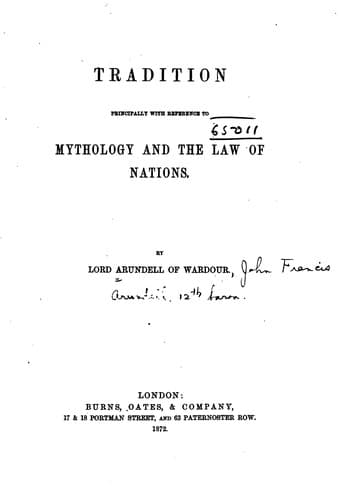
Tradition, Principally with Reference to Mythology and the Law of NationsArundell of Wardour, John Francis Arundell, Baron
Philosophy
Tradition, Principally with Reference to Mythology and the Law of Nations
Arundell of Wardour, John Francis Arundell, Baron
International law; Macdonell, George, 1780-1870; Mythology; Natural law; Tradition (Theology)
Other instances might doubtless be adduced. My present object is merely
to suggest that there may be truths in tradition not dreamt of by
modern philosophy. If the human intellect were as capacious as it is
acute, we might then listen with greater submission to its strictures
upon tradition; because then we might at least believe that its
vision extended to all the facts. But in truth, no intellect, however
encyclopædic, can grasp them all. Indeed, knowledge in many departments
is becoming more and more the tradition of experts, and must be
taken by the outside world on faith. How many facts, again, once in
tradition, but at some period put on record, lie as deeply shrouded
in the dust of libraries as they had previously lain hidden in the
depths of ages? Who will say what facts are traditional in different
localities? Barely do we move from place to place without eliciting
some information strange and new. Who again will say what ideas are
traditional in different minds? Barely is there a discussion which
provokes traditional lore or traditional sentiment which does not bring
to light some such thought or experience, re-appearing, like the lines
in family feature, after the lapse of several generations.
Whenever, then, mankind is called upon to discard its traditions at the
voice of any intellect, however powerful, is it unreasonable to demand
that some cognizance should be taken of these facts.[117]
[117] I have elsewhere (_vide_ ch. iv., _et seq._, x., xi.) traced
the tradition of the Deluge, of the chronology of the world,
&c., &c.
Let us now, returning to the tradition we have more especially in view,
ask this further question,--What could the human intellect have done
towards the regeneration of the race if there had been no revelation
and no tradition?
It is not often that unbelief is constructive and supplies us with the
necessary data with which to furnish the answer. But recently a work
which is said to embody considerable learning has appeared, entitled,
"The Origin and Development of Religious Belief," which is written
"from a philosophic and not from a religious point of view;" in which
"the existence of a God is not assumed, the truth of revelation is not
assumed," and "the Bible is quoted not as an authoritative, but as an
historical record open to criticism."--Mr Baring Gould, "Origin and
Development of Religious Belief," preface, 1869.
Here then, if anywhere, we are likely to get the solution from the
point of view of unbelief.
At p. 119, Mr B. Gould thus summarises his views:--
Public-domain text, read in full here on John Shaqi.
Reviews
Reviews
No reviews yet
Be the first to share your thoughts on this work.
Elsewhere in the archive
Join the Discussion
Join the discussion
Sign in to leave a comment or review.
Sign InorCreate an account