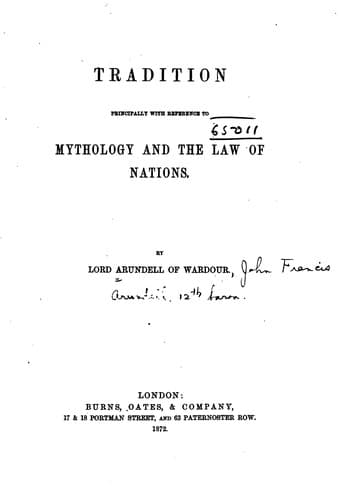
Tradition, Principally with Reference to Mythology and the Law of NationsArundell of Wardour, John Francis Arundell, Baron
Philosophy
Tradition, Principally with Reference to Mythology and the Law of Nations
Arundell of Wardour, John Francis Arundell, Baron
International law; Macdonell, George, 1780-1870; Mythology; Natural law; Tradition (Theology)
"Religion, as has been already shown, is the synthesis of thought
and sentiment. It is the representation of a philosophic idea. It
always reposes on some hypothesis. At first it is full of vigour,
constantly on the alert to win converts. Then the hypothesis
is acquiesced in, it is received as final, its significance
evaporates. The priests of ancient times were also philosophers,
but not being able always to preserve their intellectual
superiority, their doctrines became void of meaning, hieroglyphs
of which they had lost the key; and then speculation ate its way
out of religion, and left it an empty shell of ritual observance,
void of vital principle. Philosophy alone is not religion, nor is
sentiment alone religion; but religion is that which, based on an
intelligent principle, teaches that principle as dogma, exhibits
it in worship, and applies it in discipline. Dogma worship and
discipline are the constituents, so to speak, the mind spirit, and
body of religion."--"_Origin and Development of Religious Belief._"
By S. Baring Gould, M.A. Rivingtons, 1869. Part i., p. 119.
Here it is said that "religion is the representative of a philosophic
idea. It always reposes on some hypothesis." This philosophic idea
may be that there must necessarily be a Creator. But also it may not
be, for "the existence of God is not assumed" (_vide_ preface).
If it is not, then, according to this definition, religion may be
the representative of any philosophic idea (_i.e._ any idea of any
philosopher), even that which may be diametrically opposed to the
existence and goodness of God.[118] But if, on the other hand, the
existence of God is this primary philosophic idea, then all other
philosophic ideas must succumb to it. It is a point which you must
settle at starting in your definition of religion.
[118] Devil-worship is based upon the hypothesis that the evil
spirit exists, and is the influence from which man has most
to dread. Prudence suggests that it is wise to propitiate
evil when it is powerful; and if "the existence of God is not
assumed," or the conception of God not yet developed, it is
hard to see how the conclusion can be impugned; and (_vide_
next page) Mr Baring Gould endorses Grimm's opinion that man's
first "idea of God is the idea of a _devil_."
Public-domain text, read in full here on John Shaqi.
Reviews
Reviews
No reviews yet
Be the first to share your thoughts on this work.
Elsewhere in the archive
Join the Discussion
Join the discussion
Sign in to leave a comment or review.
Sign InorCreate an account