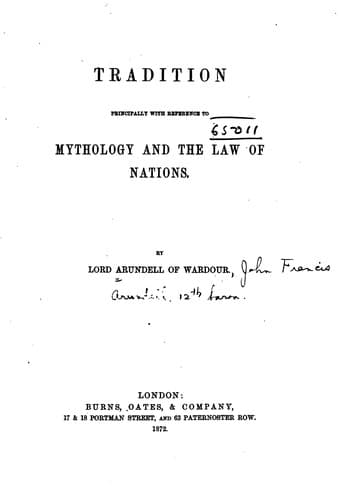
Tradition, Principally with Reference to Mythology and the Law of Nations — John Shaqi
Tradition, Principally with Reference to Mythology and the Law of NationsArundell of Wardour, John Francis Arundell, Baron
Philosophy
Tradition, Principally with Reference to Mythology and the Law of Nations
Arundell of Wardour, John Francis Arundell, Baron
International law; Macdonell, George, 1780-1870; Mythology; Natural law; Tradition (Theology)
As I have already said, although Colonel Macdonell commanded the larger
force, and by an independent command, at the action of Chateaugay, his
name is not mentioned in Sir G. Prevost's dispatch, nor in Alison,
who apparently follows the official account (xix. 131, 7th ed.) In
Alison, De Saluberry is called, by a clerical error, De Salavary--such,
after all, is fame! saith Hyperion. Although his troops, raw levies,
broke, and Colonel De Saluberry was virtually a prisoner when Colonel
Macdonell came up to the support, it was through no fault of his
disposition of his men--(Colonel Macdonell always spoke of him as an
excellent officer, who behaved on the occasion in the most noble and
intrepid manner).
The American troops at Chateaugay are variously stated at 7000 to
5700 (Alison says, "4000 effective infantry and 2000 militia, and 10
guns," xix. 131). The British, 300 French Canadian militia, under De
Saluberry; 600 under Colonel Macdonell, and some Indians, without
artillery.
A full, but, Colonel Macdonell said, inaccurate account (from
imperfect information) will be found in Mr W. James' "Military
Occurrences," above referred to.
I extract the following passages, i. 307:--"The British advanced corps,
stationed near the frontiers, was commanded by Lieutenant-Colonel De
Saluberry of the Canadian Fencibles, and consisted of the two flank
companies of that corps and four companies of voltigeurs, and six
flank companies of embodied militia and Chateaugay chasseurs, placed
under the immediate orders of Lieutenant-Colonel Macdonell, late of
the Glengarrys, who so distinguished himself at Ogdensburg. The whole
of this force did not exceed 800 rank and file. There were also at the
post 172 Indians under Captain Lamotte." Colonel Macdonell's account
differed substantially. It has been already mentioned that he had
brought up his troops by a forced march the night before, and held
them under a separate command. I conclude with the following passage
as bearing out Colonel Macdonell's version:--"The Americans, although
they did not occupy one foot of the 'abatis,' nor Lieutenant-Colonel
De Saluberry retire one inch from the ground on which he had been
standing, celebrated this partial retiring as a retreat.... By way of
animating his little band when thus momentarily _pressed_" [Colonel
Macdonell's version was, that although the troops were driven back,
Colonel De Saluberry literally "refused to retire one inch himself,"
and virtually remained a prisoner until--] Colonel De Saluberry
ordered the bugleman to sound "the advance. This was heard by
Lieutenant-Colonel Macdonell, who thinking the Colonel was in want of
support, caused his own bugles to answer, and immediately advanced with
two ['six'] of his companies. He at the same time sent ten or twelve
buglemen into the adjoining woods with orders to separate ['widely'],
and blow with all their might. This little 'ruse de guerre' led the
Americans to believe that they had more thousands than hundreds to
Public-domain text, read in full here on John Shaqi.
Reviews
Reviews
No reviews yet
Be the first to share your thoughts on this work.
Join the Discussion
Join the discussion
Sign in to leave a comment or review.
Sign InorCreate an account