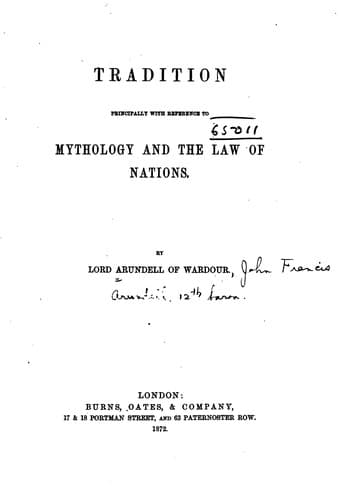
Tradition, Principally with Reference to Mythology and the Law of NationsArundell of Wardour, John Francis Arundell, Baron
Philosophy
Tradition, Principally with Reference to Mythology and the Law of Nations
Arundell of Wardour, John Francis Arundell, Baron
International law; Macdonell, George, 1780-1870; Mythology; Natural law; Tradition (Theology)
contend with, and deterred them from even attempting to penetrate the
'abatis.'"
For the rest of the account I must refer my readers to Mr W. James'
"History," as above; though, if a complete and accurate account of
an engagement which probably saved British Canada were ever thought
desirable, Colonel Macdonell's commentaries (MS.) on the above and the
official accounts, would afford valuable supplementary information.[5]
[5] The following corrections have been supplied to me by the
Hon. L. D.:--"Lieut.-Colonel George Macdonell was born on
the 12th August 1780, at St Johns, Newfoundland, where his
father, Captain Macdonell, was stationed. He was the second
son of Captain Macdonell (who had been one of the body-guard
of Prince Charles), by his wife, Miss Leslie of Fetternear,
Aberdeenshire. George was rated on the navy by the Admiral of
the station, who was a personal friend of Captain Macdonell,
and his name accordingly remained on the list for years, but
he never joined. I believe he entered in 1795 the regiment
raised by Lord Darlington, and afterwards served with the Duke
of York in the war in Holland. He was, I know, at one time in
the 8th infantry, for I remember Sir Greathed Harris saying
that he was always a well-remembered and honoured officer
in that regiment. He ultimately had the post of Inspecting
Field-Officer in Canada."
TRADITION
PRINCIPALLY WITH REFERENCE TO
MYTHOLOGY AND THE LAW OF NATIONS.
TRADITION
PRINCIPALLY WITH REFERENCE TO
MYTHOLOGY AND THE LAW OF NATIONS.
CHAPTER I.
_THE LAW OF NATIONS._
The increasing number of essays, pamphlets, works, and reviews of
works on speculative subjects, with which the literature of England at
present teems, compels the conclusion that the public mind has been
greatly unsettled or strangely transformed since the days when John
Bull was the plain matter-of-fact old gentleman that Washington Irving
pleasantly described him.
Remembering the many sterling and noble qualities whimsically
associated with this practical turn of mind, it will be felt by many to
be a change for the worse. But if old English convictions, maxims, and
ways of thought have lost their meaning; if in fine it is true that the
mind of England has become unsettled, it says much for the practical
good sense of Englishmen that they should have overcome their natural
repugnances, and should so earnestly turn to the discussion of these
questions, not indeed with the true zest for speculation, but in the
practical conviction that it is in this arena that the battle of the
Constitution must be fought.
Public-domain text, read in full here on John Shaqi.
Reviews
Reviews
No reviews yet
Be the first to share your thoughts on this work.
Join the Discussion
Join the discussion
Sign in to leave a comment or review.
Sign InorCreate an account