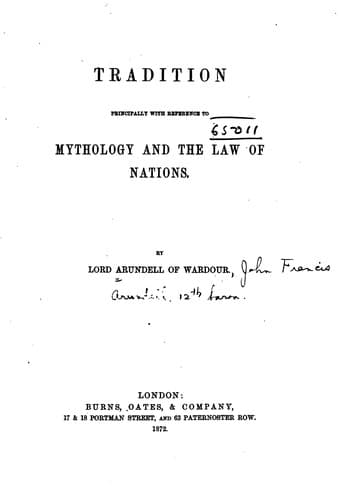
Tradition, Principally with Reference to Mythology and the Law of NationsArundell of Wardour, John Francis Arundell, Baron
Philosophy
Tradition, Principally with Reference to Mythology and the Law of Nations
Arundell of Wardour, John Francis Arundell, Baron
International law; Macdonell, George, 1780-1870; Mythology; Natural law; Tradition (Theology)
[137] Mr Max Müller, in his essay on "Semitic Monotheism,"
when opposing M. Renan's view that the monotheism of the
Semitic race was instinctive, seems to say this still more
explicitly--"He thunders and Dyaus thunders became synonymous
expressions; and by the mere habit of speech He became Dyaus
and Dyaus became He" ("Chips," i. 358). "At first the names of
God, &c., were honest attempts at expressing or representing
an idea which could never find adequate expression or
representation.... If the Greeks had remembered that Zeus
was but a name or symbol of the Deity, there would have been
no more harm in calling God by that name than by any other"
(359). It must be remembered that after the name of "Zeus,"
or "Dyaus," = sky, had been adopted, they still retained
the conception of the Divine nature and personality, as is
evidenced in the words of the oracle of Dodona--"[Greek: Zeùs
ên, Zeus éstín, Zeus essetai ô megale Zeu],--He was, He is, He
will be, O great Zeus!"
Also (ii. 15) in the Orphic lines--
"Zeus is the beginning, Zeus the middle;
Out of Zeus all things have been made."
If we are agreed upon this, then I have no contention with
Mr Max Müller; but with Max Müller as an auxiliary, I direct
my argument to the attack of Dr Dollinger's position ("The
Gentile and the Jew," I. B. ii. p. 64)--"The beginnings of
Greek polytheism," viz., "the deification of Nature and her
powers, or of particular sensible objects, _lay at the root of
all the heathen religions_, as they _existed from old time_,
amongst the nations now united under the Roman empire."
According to Mr Lewes ("Hist. of Phil.," i. 44), it
was Xenophanes who first confused the sky with the
Deity--"Overarching him was the deep blue infinite
vault, immovable and unchangeable, embracing him and all
things--_that he proclaimed_ to be God." (Contrast the
Peruvian tradition, _infra_, p. 304.) St Clement of
Alexandria (Strom. v. p. 601, Max Müller, chapter i. p. 366.)
says, on the contrary, that Xenophanes maintained that there
was but "one God, and that he was not like unto men, either in
body or mind."
Take, again, the following passage from Mr Max Müller (p. 107)--"The
idea of a young hero, whether he is called _Baldr_, or Sigurd, or
Sigrit, or Achilles, or Meleager, or Kephalos, dying in the fulness of
youth--a story so frequently told, localised, and individualised--was
first suggested by the sun dying in all his youthful vigour, either at
the end of a day, conquered by the powers of darkness, or at the end
of the sunny season, stung by the thorn of winter."
Here is a myth evidently very widely diffused. Let it be interpreted by
what is told us at p. 108--
Public-domain text, read in full here on John Shaqi.
Reviews
Reviews
No reviews yet
Be the first to share your thoughts on this work.
Elsewhere in the archive
Join the Discussion
Join the discussion
Sign in to leave a comment or review.
Sign InorCreate an account