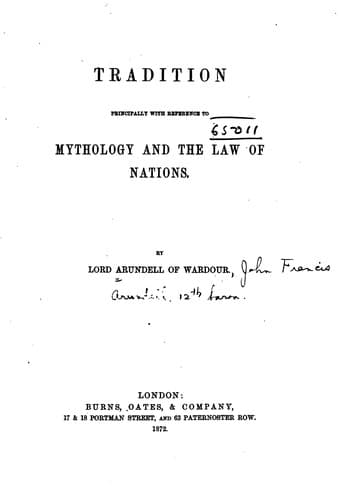
Tradition, Principally with Reference to Mythology and the Law of NationsArundell of Wardour, John Francis Arundell, Baron
Philosophy
Tradition, Principally with Reference to Mythology and the Law of Nations
Arundell of Wardour, John Francis Arundell, Baron
International law; Macdonell, George, 1780-1870; Mythology; Natural law; Tradition (Theology)
"_Baldr_, in the Scandinavian Edda, the divine prototype of Sigurd
and Sigrit, is beloved by the whole world. Gods and men, the whole
of nature, all that grows and lives, had sworn to his mother not to
hurt the bright hero. The mistletoe alone, that does not grow on
the earth, but on trees, had been forgotten, and with it Baldr was
killed at the winter solstice....
Baldr, whom no weapon pierced or clove,
But in his breast stood fix'd the fatal bough
Of mistletoe, which Lok, _the accuser, gave
To Hoder_, and the unwitting Hoder threw;
'Gainst that alone had Baldr's life no charm."
"Thus Infendiyar, in the Persian epic, cannot be wounded by any
weapon.... _All these are fragments of solar myths_." One hardly likes
to disturb such illusions. Solar myths! well, allow me at least to
repeat the history which seems to me so very like this myth. Many
centuries ago, in a beautiful garden which a concurrence of tradition
places somewhere in Central Asia, a man, the first man of our race,
framed according to the "divine prototype," dwelt beloved by the whole
world. God and the angels, and the whole of nature--all that grows and
lives, were agreed that nothing should do him harm. One fruit or growth
alone--the mistletoe it may have been--something that does not grow on
the earth, but on trees, was excepted; and it was told to this man,
whose name was--but we will not anticipate--that on the day on which
he touched this fruit he should die the death. It so came about that
the accuser, whom some call the serpent, had previously handed it to
his companion, and his unwitting companion gave it to him. He took it,
and he died. Against that fatal bough his life had no charm. No weapon
pierced or clove him; for Baldr--I should say Adam--was invulnerable,
as was Achilles and Meleager, except in one single respect.
I believe that instances might be indefinitely multiplied. I shall
content myself, however, with the following, which I think will be
generally considered among the happiest illustrations of nature
worship.[138]
[138] Granting the tendency to nature-worship, I conclude that the
conspicuous luminaries of the heavens would become primary
objects of such worship. In amusing illustration of this I
remember a friend of mine telling me that he happened to ask
a young lad, the son of one of his tenants, who had just
returned from a voyage to the Northern seas, how he liked his
captain? He said, "Oh, he was an _awful_ man--he swore by the
_sun, moon_, and _stars_." Still less do I deny the tendency
to sun-worship. It was, as Gibbon tells us (ii. 438, iii.
150), the last superstition Constantine abandoned before his
conversion, and the first to which Julian betook himself after
his apostacy.
Public-domain text, read in full here on John Shaqi.
Reviews
Reviews
No reviews yet
Be the first to share your thoughts on this work.
Elsewhere in the archive
Join the Discussion
Join the discussion
Sign in to leave a comment or review.
Sign InorCreate an account