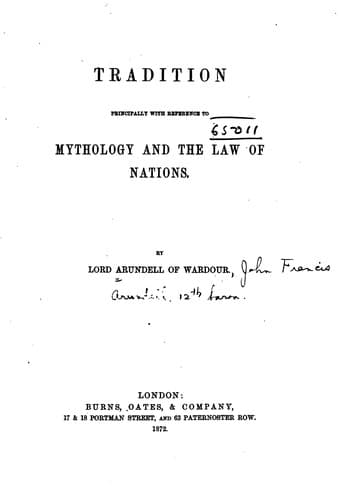
Tradition, Principally with Reference to Mythology and the Law of NationsArundell of Wardour, John Francis Arundell, Baron
Philosophy
Tradition, Principally with Reference to Mythology and the Law of Nations
Arundell of Wardour, John Francis Arundell, Baron
International law; Macdonell, George, 1780-1870; Mythology; Natural law; Tradition (Theology)
It may, moreover, be urged, that the sun figures in all these
legends. I say, on the other hand, so also does the _serpent_.
This serpent may be the serpent "of _darkness_," and still
be the serpent of _tradition_, but how darkness or night is
aptly personified by a serpent I am at a loss to perceive.
Then again the sun _may_ always be only the symbol of what
is bright and heavenly. But when (Max Müller, ii. 171) we
see this serpent Zohak, called by the Persians "by the name
of Dehak, _i.e., ten evils_, because he introduced "_ten
evils into the world_," we cannot help recalling the profane
expressions attributed to the devil when he saw the ten
commandments--proscribing the _ten_ evils in question.
"And as it is with this sad and beautiful tale of Orpheus and Euridike
(Euridice). [The story of Euridice was this--'Euridice was bitten by
_a serpent_, she dies, and descends into the lower regions. Orpheus
follows her, and obtains from the gods that his wife should follow
him if he promised not to look back, &c.' It reads to me like a sad
reminiscence of Adam and Eve.] Mr Max Müller proceeds--'so it is with
all those which may seem to you coarse, or dull, or ugly. They are so
only because the real meaning of the names has been half-forgotten or
wholly lost. OEdipus and Perseus (_vide_ Appendix), we are told,
killed their parents, but it was only because the sun was said to kill
the darkness from which it seemed to spring.'"[139]
[139] Mr Max Müller may perhaps lay stress upon the circumstance
that Baldr dies at the winter solstice. But this equally bears
out the tradition noticed by Lenormant, that immediately after
the Fall, there came upon the world a great cold. (_Vide
supra_, ch. vii.)
But why is darkness called the parent of the sun, and not rather light
the parent of darkness? and why not a contrary legend founded on this
surmise? Is it merely accidental that the metaphor is not reversed?
Compare the above speculation of Mr Max Müller's with the following
passage from Gainet, "Hist. de l'Ancien. Nouv. Test.," i.; "Les
Souvenirs du genre Humain," p. 79:--
"Chaos was placed at the commencement of all things in the
Phoenician cosmogony (Euseb. Præp. Evan. l. i.), as in that of
Hesiod (Theog., p. 5). The latter calls upon the Muses to tell
him what were the beings that appeared first in existence, and he
replies--'At the commencement of all things was Chaos, and from
Chaos was born Erebus and dark night.'
"Thus, in the order of existence, as in the order of time, there is
a concurrence of profane tradition to place night before day. This
is the reason why the Scandinavians, the Gauls, the Germans, the
Kalmucks, the Numidians, the Egyptians, and Athenians, according to
Varro and Macrobius, count their days, commencing with sunset and
not with sunrise."
Public-domain text, read in full here on John Shaqi.
Reviews
Reviews
No reviews yet
Be the first to share your thoughts on this work.
Elsewhere in the archive
Join the Discussion
Join the discussion
Sign in to leave a comment or review.
Sign InorCreate an account