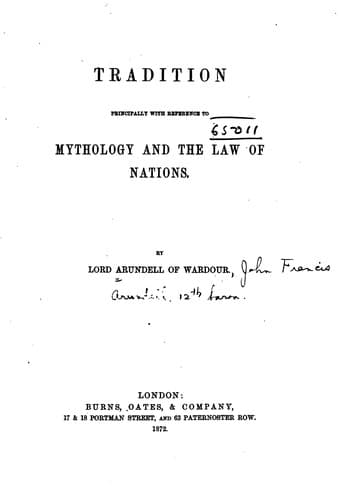
Tradition, Principally with Reference to Mythology and the Law of NationsArundell of Wardour, John Francis Arundell, Baron
Philosophy
Tradition, Principally with Reference to Mythology and the Law of Nations
Arundell of Wardour, John Francis Arundell, Baron
International law; Macdonell, George, 1780-1870; Mythology; Natural law; Tradition (Theology)
Curiously enough, in another chapter on a different subject, Mr
Max Müller enables me to clinch this argument against himself. In
an article on the "Norsemen in Iceland," he says--in proof of the
genuineness of the Edda--"There are passages in the Edda which sound
like verses from the Veda." But what are these verses from the ends of
the earth which are identical? Let us listen--
"'Twas the _morning_ of _time_
When yet _naught was_,
Nor sand nor sea were there,
Nor cooling streams;
Earth was not formed,
Nor _Heaven_ above;
A yawning gap there was,
And grass nowhere."[140]
[140] From the "Elder Edda." (Quoted from Dr Dasent's "Norsemen in
Iceland." Oxford Essays, 1858.)
Under these conditions, I think it will be conceded that there was also
darkness--and therefore, that the tradition of the precedence of chaos
and darkness is confirmed.
"A hymn," continues Mr Max Müller, "of the Veda begins in a very
similar way--
"Nor aught, nor naught existed; yon _bright sky
Was not_, nor Heaven's broad roof outstretch'd above,
What cover'd all? what shelter'd? what conceal'd?
Was it the waters' fathomless abyss?" &c.
Mr Max Müller adds, "There are several mythological expressions common
to _the Edda_ and _Homer_. In the Edda, man is said to have been
created out of an _ash tree_. In Hesiod, Zeus created the third race
of men out of _ash_ trees, and that this tradition was not unknown to
Homer we learn from Penelope's address to Ulysses--"Tell me thy family
from whence thou art: for thou art not sprung from the olden trees, or
from the rocks" (Max Müller, ii. 195).
The tradition about the ash tree in Hesiod, Homer, and the Edda,[141]
is curious but inexplicable: the general drift of the tradition may be
determined by the recollection of two facts--that man was created,
and that a tree was inseparably connected with his history from its
earliest commencement. But I have quoted the passage more especially
with reference to its confirmation of the extract from Gainet, which
attests the wide-spread tradition--so exactly in accordance with the
cosmogony of Scripture--that Chaos was at the commencement of all
things, and that darkness existed before light.[142] I conclude by
asking why this should be? When we are in the midst of solar and
astral systems and legends, it seems natural that a theory of cosmogony
should commence with light rather than darkness--at least, as well
that it should commence with light as with darkness. But no, the
universal tradition seems against it. Much more strange is this if we
connect the solar and astral legends with any system of Sabaism. These
considerations make it plain to me that the solar and astral legends
embodied anterior traditions.
Public-domain text, read in full here on John Shaqi.
Reviews
Reviews
No reviews yet
Be the first to share your thoughts on this work.
Elsewhere in the archive
Join the Discussion
Join the discussion
Sign in to leave a comment or review.
Sign InorCreate an account